How to choose a K-5 phonics program
Choosing the right phonics program is a high-impact decision that shapes how effectively students learn to read. This guide highlights what research says about strong phonics instruction and how to evaluate programs for quality and fit. With the right approach, school leaders can ensure every K–5 student builds a solid foundation for lifelong literacy.
A post from our Literacy learning: Science of reading blog series written by teachers, for teachers, this series provides educators with the knowledge and best practices needed to sharpen their skills and bring effective science of reading-informed strategies to the classroom.
Choosing the right phonics program is one of the most consequential decisions a school leader can make. This guide walks through what research says about effective phonics instruction, what to look for in a high-quality program, and how to evaluate fit for your school or district—so every student has the foundation they need to become a confident, capable reader.
Selecting a K-5 phonics program for your school or district is about more than choosing a curriculum from a list. It is a decision that will shape whether and how thousands of students learn to read. The right program, implemented with integrity, can set students on a trajectory toward lifelong literacy. The wrong one, or the right one implemented poorly, can leave critical gaps that compound over time. This guide is designed to help school leaders ask the right questions, understand what the research says, and make an informed decision that serves every student in grades K–5.
Why a strong phonics program matters in K-5
Reading is not something the human brain does naturally. Unlike spoken language—for which we are born with the cognitive preparedness and for which we have specialized areas of brain architecture—reading is not innate and therefore the neural circuitry must be developed, through instruction Educational psychologist David C. Geary coined the phrase “biologically secondary knowledge” to refer to cultural inventions that have not been part of our evolutionary history long enough to be “hardwired”; reading therefore is biologically secondary. Spoken language is “biologically primary, “meaning humans acquire speech relatively easily because it has been essential over time; we generally do not require formal instruction to master speech. Reading requires us to map written symbols onto the sounds of spoken language, a process that does not happen on its own.
Neuroscientist Stanislas Dehaene’s research on Reading in the Brain (2009) helps explain why. Unlike speech, there is no “reading module” in the human brain. To read, the brain must recycle existing neural regions originally designed for other primary functions, such as object recognition (the ability to recognize shapes and patterns) and oral language processing, and build pathways between those functions. Phonics instruction is what builds that bridge. It connects letters to sounds across the different language-processing areas of the brain, creating the neural pathways that make fluent reading possible.

Learning to read is not natural. Our brains are not designed for learning to read, so our brain actually builds on biologically primary functions of speech and language.
Jennifer Delano-Gemzick, EdD
Research also tells us that the amount of time devoted to foundational skills instruction matters enormously. Studies by researcher and literacy advocate Louisa Moats (2019) indicate that approximately 30 minutes of daily foundational skills instruction—particularly in the early grades—is essential for building the skills students need to become fluent readers. Without that consistent, structured time, students fall behind. And once they fall behind, the gap tends to widen. This is what researchers call The Matthew Effect (the rich get richer, the poor get poorer) in reading: students who read well read more, which makes them better readers, while students who struggle read less, which causes them to fall further behind—often dramatically so by third grade.
How phonics fits into structured literacy
Although phonics programs have gotten a lot of attention over the last few years, phonics does not exist in isolation. It is one essential component of a broader approach known as structured literacy. This addresses all the language components—and systems they live within—that students require to become proficient readers and writers. Dr. Maryanne Wolf, author and director at the Center for Dyslexia, Diverse Learners, and Social Justice at the UCLA Graduate School of Education and Information Studies, frames this idea that children engage with words through six integrated elements that lead to fluent comprehension. She uses the acronym POSSUM (Phonology, Orthography, Syntax, Semantics, Understanding and Morphology) to explain it.
- Phonology: the sound system of language—understanding that words are made up of individual sounds (phonemes) that can be manipulated.
- Orthography: the writing system—how sounds map to letters and letter patterns.
- Semantics: meaning—beyond just vocabulary instruction—the study of the multiple meanings and associations of a word—building a network around the semantic areas of the brain. Connecting to the visual pattern of the word and phonemic representation of the word.
- Syntax: sentence structure—how words are organized to convey meaning.
- Understanding: understanding at the foundational level that a word is made of sounds, and sounds are represented by specific letter(s), and also understanding what a word means in the context of a sentence, a paragraph, or a story.
- Morphology: the study of meaningful word parts—prefixes, suffixes, roots, and base words.
Fluent reading emerges when all of these systems work together seamlessly. A high-quality phonics program should be grounded in this framework, building each component in a logical, well-sequenced progression.

See structured literacy in action
To better understand how these elements work together, explore the Structured Literacy grounded in the science of reading infographic from the International Dyslexia Association—a helpful visual that brings the POSSUM framework to life.
The role of phonics in K-5 growth
One of the most important concepts to understand about phonics instruction is that it is not a single skill—it is a continuum of skills that develops from simple to complex across the elementary years. The right solution supports students through each stage of that continuum. Here is what that progression looks like.
- Kindergarten: Students learn the foundational building blocks—individual sounds and their corresponding symbols. The emphasis is on phonemic awareness and the alphabetic principle: understanding that letters represent sounds.
- First grade: Instruction moves into blending sounds to read single-syllable words. Students learn closed syllables, open syllables, silent-e syllables, blends, digraphs, and common phonogram patterns (rime units) that help build reading fluency. Toward the end of first grade, students begin working with two-syllable words and are introduced to derivational morphology through common suffixes like -ing, -ed, and -ies.
- Second grade: Students expand to one- and two-syllable words with more complex vowel patterns, and silent letters. Morphology instruction at this stage focuses primarily on how morphemes affect spelling and ultimately meaning—students begin to understand that adding something to a word can shift both the way it’s spelled and the meaning of the word.
- Grades 3–5: The focus now shifts to multisyllabic words. “We’re essentially teaching students that they’ve got two tools in their toolbox that they can use to figure out unknown words,” Gemzik explains. “The first one is syllable types—which will help them to pronounce the word, and the second one is morphology—which will help them to figure out what the word means.” This is also where vocabulary development becomes increasingly critical.
In fact, research cited in The Vocabulary Book, by Michael F. Graves, indicates that students in second grade and beyond need to learn approximately 2,000–3,000 new words per year to keep up with academic demands. Gemzik digs deeper on this. “By fourth grade, about 65% of the words students encounter in print are multisyllabic—primarily derived from Latin and Greek roots, the Tier 2 (high-utility) and Tier 3 (domain-specific) academic vocabulary that appears across content areas. (Beck, McKeown, and Kucan, 2013).”
The fact is that when a student’s oral vocabulary growth has not kept up with what the language of their texts demands, they hit what researchers Jeanne Chall and Vicki Jacobs described in American Educator (2003) as the “fourth-grade slump”—a point at which students who appeared to be on track suddenly begin to fall behind. Without intervention, those students can be two or more grade levels behind their peers by seventh grade.
Effective vocabulary instruction at the upper elementary level draws on four interconnected approaches:
- Word consciousness: Building awareness of and curiosity about language through rich read-alouds, high-level language modeling, and intentional word use
- Direct instruction: Teaching approximately 10 words per week deeply and intentionally—with repeated exposure and active use
- Independent word strategies: Teaching students to use morphology keys—understanding how prefixes, suffixes, and root words contribute to overall meaning—so they can tackle unfamiliar words on their own
- Context clues: Teaching students to use the surrounding text to refine their understanding of a word’s meaning
Strategies 3 and 4 are particularly powerful when taught together: students learn that words have parts, parts have meaning, and knowing what those parts mean can help them arrive at a working definition—which context clues can then help them refine.
Programs like Morpheme Magic™, Morphemes for Little Ones™, and 95 Vocabulary Surge: Unleashing the Power of Word Parts™ are built on these principles.

7 characteristics to look for in a high-quality phonics program
Not all phonics programs are created equal. When evaluating options, school leaders should be diligent about looking for the specific characteristics. Below are some guidelines you can use when selecting a K-5 phonics program that’s right for your district or school.
- A well-sequenced, skills-based progression: The program should move from simple to complex in a logical, research-aligned sequence: letters and sounds → words using those patterns → building and reading words. Look for a clear phonics continuum that maps skills across grade levels.
- Explicit, scripted daily instructional routines: Effective phonics instruction is highly explicit. Programs that provide clear instructional dialogue, replicable routines, and consistent lesson structures reduce cognitive load for both teachers and students—making instruction more effective and more equitable. Scripted routines are not a limitation; they are a feature. They ensure that every student receives high-quality instruction regardless of their teacher’s prior training or experience.
- Decodable texts that match the instructional sequence: Students should practice reading words and texts that reflect the phonics patterns they have been taught. Decodable texts are essential in the early stages of reading development. As students progress, the transition to “readables”—texts that are decodable but less controlled—should be gradual and intentional. By second grade, passages can begin to get longer and slightly less controlled.The purpose of decodable text is to provide temporary scaffolds, much in the same way training wheels provide supports for early bicycle riders. By fourth and fifth grade, students should be reading grade-appropriate texts, applying their syllable and morphology skills to navigate increasingly complex language.
- Strategic use of the gradual release model: Look for programs that build in explicit modeling (I do), guided practice (We do), and independent application (You do)—and that empower teachers to pull instruction back when students misunderstand or need reteaching.
- A grounding in both the science of reading and the science of learning: The components of a high-quality program should be intentional and evidence-aligned —not just in what is taught, but in how it is taught.
- Proven results: An investment in curricular resources is too important to take a chance on unproven materials. Look for programs with published evidence studies demonstrating effectiveness.
- A smooth transition beyond phonics: A strong program anticipates the full arc of reading development and supports teachers in making intentional transitions as students move from foundational phonics into more complex word study and vocabulary work.
Questions to ask when comparing phonics programs
When evaluating specific programs, the following questions can help you dig beneath the surface. We recommend using the Reading League’s curriculum evaluation tool alongside this list.
| Question | Why it matters |
|---|---|
|
How much time per day is required for the phonics block? |
Effective foundational skills instruction requires approximately 30 minutes daily. Programs that recommend significantly less may not provide sufficient practice for skill acquisition. |
|
What training and coaching does the program provide for teachers? |
Research on implementation science shows that training alone—without coaching and follow-up support—produces minimal transfer to classroom practice. Look for programs with embedded, ongoing professional learning. |
|
What does a single lesson look like, start to finish? |
A lesson walkthrough reveals whether routines are clear, whether the gradual release model is built in, and whether the pacing is realistic for your teachers. |
|
How are spelling and morphology connected to this phonics program? |
Spelling and morphology should not be separate add-ons—they should be integrated into the phonics sequence from the beginning, reinforcing the same patterns students are learning to read. |
|
How well does this program fit alongside our core ELA curriculum? |
Phonics instruction should complement, not compete with your core curriculum. Ask how the program is designed to integrate with the broader literacy block. |
|
Is there an evidence base for this program? |
Look for independent research studies, not just publisher-provided data. Ask specifically about effect sizes and the populations studied. |
Evaluating program fit for your school or district
Beyond the program itself, school leaders need to honestly assess whether the current conditions in their building or district will support an effective implementation. Here are some questions to guide this inquiry:
Do our teachers have enough time for the recommended lesson length?
Scheduling is one of the most common barriers to successful implementation. If the phonics block is not protected in the daily schedule, even the best program will underperform.
Does the sequence match our state’s foundational skills expectations?
Alignment to state standards matters for accountability—and for ensuring continuity as students move between grades and schools.
Are there enough decodable texts per student?
Insufficient materials are a frequently overlooked implementation barrier. Students need access to decodable texts that match their current instructional level in order to ensure they will have plenty of access to practice and repetition that meets them where they are.
Is the program easy to implement consistently across multiple grades?
Consistency in language, routines, and expectations across grade levels reduces cognitive load and confusion for students and teachers alike—and makes schoolwide implementation far more manageable.
Will teachers need extensive professional development, or is the program design intuitive?
Some programs require significant upfront training; others are designed to be more immediately accessible—with “learn-as-you-teach” opportunities. Be realistic about your capacity to support upfront professional learning needs.
Does the program include Tier 1, Tier 2, and Tier 3 resources with shared instructional language and routines?
When the language, routines, and expectations are consistent across tiers and grade levels, students experience a more coherent instructional experience—and teachers can collaborate more effectively across intervention levels. Learn more about 95 Percent Group’s Tier 1 and Tier 2 Phonics solution, and 95 Tier 3 Literacy Solution.
How will you track data?
A comprehensive data collection system—one where universal screening data and program assessment data align and work together—is essential for monitoring progress and making informed instructional and student grouping decisions.
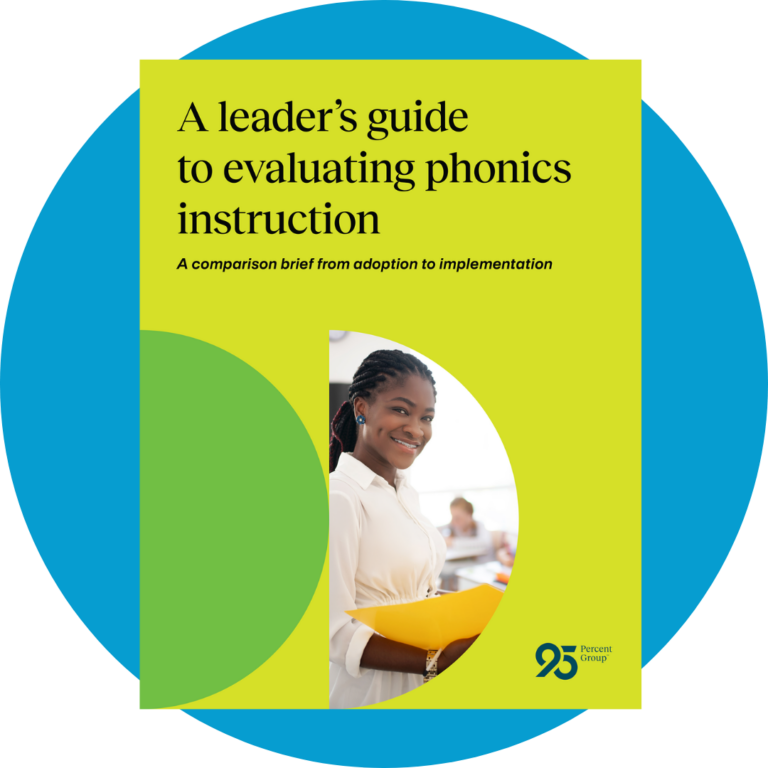
Evaluate phonics instruction beyond the program
Selecting a phonics program is only the first step. Learn how to observe instruction, identify evidence-based practices, and support effective implementation with A leader’s guide to evaluating phonics instruction.
Implementation requirements that get overlooked
Even the most carefully selected phonics program can stall or fail if implementation is not thoughtfully planned and supported. Here are some of the most commonly overlooked requirements:
- Teacher preparation time: “Because many phonics programs have specific instructional dialogue,” Gemzik explains, “teachers sometimes assume they do not need to prepare. This is a significant mistake. Teachers need to read through lessons in advance, review student data, and anticipate where students may need additional support.”
- Training and support for instructional leaders: Principals and coaches should understand the curriculum deeply—not just what it teaches, but why it was written the way it was. Without this knowledge, they cannot provide meaningful feedback to teachers or identify when implementation is drifting off course.
- Coaching from people who know the curriculum: Generic instructional coaching is not sufficient. Gemzik is particularly passionate about this one. “Teachers benefit most from coaching provided by people who understand the specific program, its sequence, its routines, and the reasoning behind its design choices.”
- A sustainability plan: What does implementation look like in year two, year three, and beyond? What are the ongoing costs—materials, training, coaching—and how will they be budgeted? Schools that plan only for the initial launch often struggle to sustain the longer term plan.
- A data tracking system that connects screening and program data: Universal screening data tells you which students need support. Program assessment data tells you whether the instruction is working. When these two data streams are aligned and accessible, instructional decision-making becomes far more precise and responsive.
The difference between successful and unsuccessful implementation often comes down to one thing: whether a school is actively making implementation happen* or simply letting it happen and hoping for the best.
*concept from researchers Joyce and Showers, 2002
Jennifer Delano-Gemzick, EdD
How 95 Percent Group supports district phonics instruction
Choosing the right program is important AND it’s only the beginning. At 95 Percent Group, we believe that implementation support can be what transforms a good program + talented teachers into lasting student outcomes. Our approach is built around the idea that protecting your investment in a phonics program means ensuring it is implemented with integrity, consistency, and ongoing refinement.
95 Tier 1 Phonics Solution provides a comprehensive, core phonics instruction + a digital practice platform for grades K–5, grounded in the science of reading. It includes explicit lessons with instructional dialogue, embedded professional learning that builds teacher knowledge as they teach, plus the option to add decodable texts aligned to the instructional sequence.
Beyond the program itself, 95 Percent Group offers:
Implementation management support that helps school and district leaders think through every stage of rollout—from scheduling and materials to data systems and sustainability planning. Our sales and professional learning staff work alongside schools to problem-solve in real time, not just at launch. Because when implementation stalls, students pay the price.
Coaching from experts who understand our curriculum deeply—why it was written the way it was, how the sequence was designed, and what effective classroom implementation looks like at every grade level.
Ongoing professional learning through virtual product workshops, webinars, ebooks, and resources throughout the year—including our Literacy leader toolkit with ready resources for every stage of the journey.
The schools and districts that see the strongest outcomes are the ones that treat implementation as an ongoing commitment—not a one-time event. We are here to support that commitment every step of the way.

Expert Biography
Jennifer Delano-Gemzik, EdD has worked in education for the past 25 years as a National ELA consultant and trainer for schools and districts on topics related to the science of reading and implementing evidence-aligned instruction. Before joining the 95 Percent Group, Gemzik worked as a national ELA consultant for the Consortium on Reaching Excellence, a National LETRS facilitator, and as a private consultant. She is a North Carolina state-certified trainer for Reading Research to Classroom Practice as well as a Dyslexia Delegate. She has served as a member of North Carolina’s ELA Advisory Committee, and as a proud parent of two children with special needs, she has volunteered with a state parent advisory group to advance literacy legislation in the state. She has also worked as an elementary school administrator, literacy coach, classroom teacher, and English as a Second Language teacher in North Carolina and overseas with the Peace Corps.
Sources
- Beck, Isabel L., Margaret G. McKeown, and Linda Kucan. Bringing Words to Life: Robust Vocabulary Instruction. 2nd ed. New York: Guilford Press, 2013.
- Chall, Jeanne S., and Vicki A. Jacobs. 2003. “The Fourth-Grade Slump.” American Educator.
- Dehaene, Stanislas. 2009. Reading in the Brain: The New Science of How We Read. New York: Viking.
- Joyce, Bruce, and Beverly Showers. 2002. Student Achievement through Staff Development. 3rd ed. Alexandria, VA: Association for Supervision and Curriculum Development.
- Lyon, G. Reid. 2001. The Research We Need to Guide Our Efforts to Ensure That All Children Can Read. Washington, DC: National Institute of Child Health and Human Development.
- Moats, Louisa C. 2019. LETRS: Language Essentials for Teachers of Reading and Spelling. Units 1 and 3. Dallas, TX: Voyager Sopris Learning
- National Center for Education Statistics. (2024). The Nation’s Report Card: 2024 Reading Assessment. U.S. Department of Education. https://www.nationsreportcard.gov
- The Reading League. 2023. Curriculum Evaluation Guidelines. Syracuse, NY: The Reading League.
- Wolf, M. (2019). The POSSUM Approach: An Anatomy of Reading. Rooted in Language. https://rootedinlanguage.com/blogs/rootedreport/possum