Spotlight Missouri: Aligned foundational literacy at scale
A large urban Missouri district transformed foundational literacy instruction by implementing 95 Percent Group’s One95 Literacy Ecosystem across K–8 classrooms, paired with sustained professional learning. The shift from inconsistent practices to a coherent, structured literacy system led to measurable gains in student achievement, reduced need for intensive intervention, and stronger teacher confidence across schools. Early results from pilot schools show significant ELA growth and increasing instructional alignment districtwide.

District Snapshot:
- 68 Schools serving 18,284 students
- 90% Minority enrollment
- 75% Free and reduced lunch
- 75% Black or African American
- 12% White
- 8% Hispanic/Latino
- 3% Asian or Asian Pacific Islander
- 2% Two or more races
A large urban Missouri district tackled inconsistent foundational literacy instruction by implementing 95 Percent Group’s One95 Literacy Ecosystem across tiers and grade levels, paired with robust professional learning. The result: growth across all student groups in pilot schools, fewer students requiring intensive reading support, and a district-wide shift in teacher confidence and instructional coherence that continues to grow.
St. Louis Public Schools located in St. Louis, Missouri, has a diverse student population and deeply committed educators who are focused on accelerating student learning. The district serves a high percentage of students who qualify for free/reduced lunch, and many campuses support English learners, students receiving special education services, and students who have experienced interrupted learning. There is also high student mobility, which makes districtwide instructional coherence—especially consistent foundational reading instruction—critical so students experience predictable routines and skill progression no matter the classroom or school.

We weren’t looking to add another program—we needed to establish a reliable system: one built on clear routines, explicit instruction, and practical materials that consistently support teachers across schools with varying needs and staffing patterns.
Deanna Kitson, Ed.D
Consistency is key
District leaders analyzed the data and remained focused on strengthening foundational reading skills across schools. This work was not about identifying a lack of effort—teachers were deeply committed—but about ensuring greater consistency so that every student, regardless of classroom or building, experienced high-quality, explicit foundational literacy instruction. Leaders recognized that increasing coherence across schools would be key to accelerating student outcomes.
To support this vision, the district prioritized establishing a more unified approach to phonics instruction. This work focused on selecting tools and resources that reinforce clear instructional routines and deliver explicit, systematic instruction within a coherent and aligned progression of skills. Equally important was investing in professional learning to ensure teachers could implement these practices with both fidelity and responsiveness to student needs.
In a district serving students with diverse needs, leaders remained grounded in the importance of every instructional decision. Their focus has been on creating the conditions for consistency, clarity, and strong foundational literacy experiences for all students.
From silos to systems: Aligned, structured literacy
After reviewing available options, district leaders selected products from 95 Percent Group’s One95 Literacy Ecosystem™. The decision was grounded in several factors: the program’s alignment to the science of reading research on how students learn to read, its inclusion on the state-approved vendor list, and the structured design of the resources—supporting consistent implementation across diverse school settings.
Here’s what it looked like:
- Grades K–5, teachers began using 95 Phonics Core Program® as their Tier 1 daily phonics block.
- Across grades K–8, 95 Phonics Lesson Library™ became the foundation for Tier 2 intervention.
- In grades 6–8, Morpheme Magic and the Multisyllable Routine Cards were introduced to strengthen students’ decoding skills and morphological analysis—giving older students the tools they needed to tackle the complex academic vocabulary that appears across every subject area.
The district knew that the changes they saw were not just from the materials themselves, but what the materials made possible. The lessons provided teachers with clear instructional routines, predictable skill sequences, and common instructional language. For the first time, coaches and administrators had a shared set of “look-fors” they could use to observe classrooms, provide precise feedback, and monitor implementation across the district.
Teachers reported that the explicit structure reduced prep time, increased their confidence, and helped them deepen their own knowledge in how foundational skills build over time. Because the routines were consistent and the language was shared, teachers felt more equipped to support diverse learners—and students experienced less cognitive load, freeing up more mental energy for actual learning.
The shift towards an aligned approach
The professional learning support that accompanied the program is equally important. Ensuring that routines are taught consistently and that teachers understand the why behind each instructional move requires ongoing time and financial investment in professional learning. And their investment paid off. As teachers grew more confident in their practice, school leaders grew more confident in their ability to support them; spending more time in classrooms, using common language in coaching conversations, and building stronger systems for feedback and accountability.
Deanna Kitson, Network 5 Superintendent for St. Louis Public Schools, shared how one principal captured this building-wide shift in a moment that has stayed with her.
“She described walking into classrooms across grade levels and hearing the same instructional language, watching students engage in familiar routines, and noticing fewer students shutting down during reading time.” Kitson explained, “It was a clear shift toward a more unified and coherent approach—one that supported both teachers and students and could be sustained over time.”
Growth and momentum
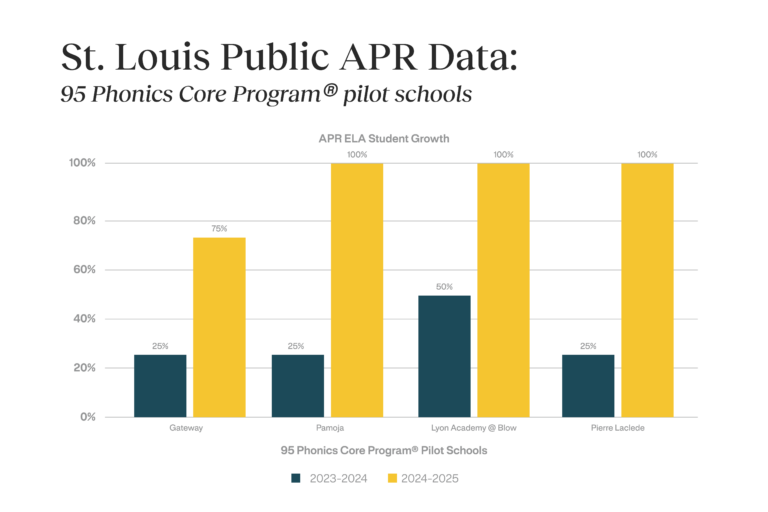
The 2024–2025 pilot results were striking. Of the four schools implementing the Phonics Core Program that year, they all achieved 100% target growth for all student groups, and among students that historically score below the state average, growth reached 94%. Overall ELA academic achievement growth on the Annual Performance Report came in at 88%. Every pilot school showed growth in ELA—a result that reflects both stronger instructional practice and meaningful gains in foundational skills acquisition for students.
The momentum has continued into the 2025–2026 school year. Schools are reporting fewer students requiring intensive reading support—an early indicator that stronger foundational instruction is helping more students build critical skills before gaps become entrenched.
Confidence, cohesion, and clarity
Although the data is encouraging, it’s the shift in day-to-day classroom experiences that makes the difference. Students are more consistently engaged in structured routines and are building confidence as they develop foundational skills. Teachers report greater alignment and clarity in their instruction, and district leaders feel more equipped to guide the work with purpose—analyzing needs, supporting implementation, and ensuring instruction reflects how students learn to read.
The future is bright
Looking ahead, the district is most excited about what these early gains point toward: more students becoming confident, capable readers who can successfully access grade-level content and fully engage in the rich learning experiences their schools are designed to provide.
Kitson weighed in on this last part. “The foundation is being built. The system is coming together. And the changes we see in the students—all of them—are at the center of every decision.”
Ready to learn more? Contact a literacy specialist.