Literacy screeners vs. diagnostics: What school leaders should know
What’s the difference between literacy screeners and diagnostic assessments—and when should schools use each? This guide breaks down how both tools work together to identify struggling readers and inform targeted instruction.
A post from our Literacy learning: Science of reading blog series written by teachers, for teachers, this series provides educators with the knowledge and best practices needed to sharpen their skills and bring effective science of reading-informed strategies to the classroom.
Effective literacy assessment is the cornerstone of successful reading instruction, yet many educators struggle to understand when and how to use different assessment types. This comprehensive guide will help school leaders navigate the critical differences between literacy screeners and diagnostics, empowering them to make informed decisions that drive student engagement and success.
Why assessment matters in literacy education
Assessment serves as the foundation for all instructional decision-making in literacy education. Without proper assessment data, educators are essentially “teaching in the dark”—unable to identify student needs or measure progress effectively.
Jennifer Delano-Gemzik, EdD, literacy expert and consultant for 95 Percent Group™, weighs in on four different types of literacy assessments. “A comprehensive literacy assessment system typically includes four distinct types of assessments and each serves a unique purpose in a literacy ecosystem.”
*We recognize that assessments are also regularly used to identify students who are above grade level benchmark and are in need of enrichment and extension intervention. For the purpose of this Literacy Learning piece, we will focus primarily on below-benchmark assessments and intervention.
Assessment types include:
- Universal screeners identify students who may be at risk for reading difficulties and need additional support or intervention.
- Diagnostic assessments provide detailed information about specific skill deficits to guide targeted instruction and intervention planning.
- Progress monitoring assessments track student growth over time to determine if interventions are working effectively and whether students are ready to move on.
- High-stakes benchmark assessments measure overall system health and often determine funding and accountability measures at the state level.
“It’s crucial for instructional leaders to understand one thing about high-stakes assessments,” Gemzik said. “While they are important for accountability, they don’t provide actionable data for classroom instruction. These types of tests can confirm that an issue exists, but reveal nothing about what’s causing the problem or how to address it.” She continued. “Schools scoring below proficiency thresholds over multiple years can face state takeover, but these assessments tell us nothing about individual student needs.”
What is a literacy screener?
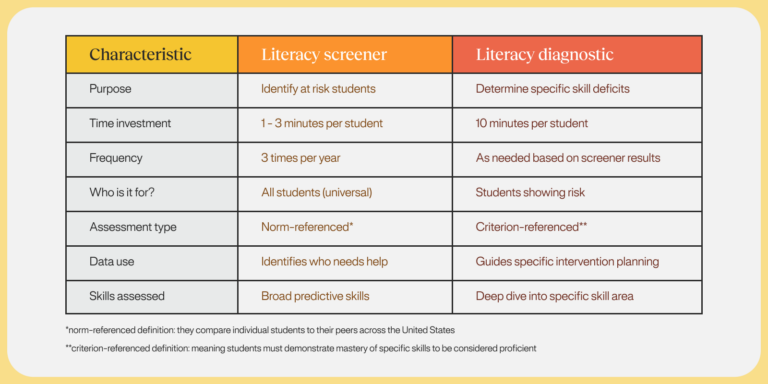
A universal literacy screener is a brief assessment designed to quickly identify students who may be at risk for reading difficulties. These assessments are typically administered three times per year—at the beginning, middle, and end of the school year—to all students in a grade level or school.
Popular examples include DIBELS, Acadience, and AIMS Web. These screeners are intentionally designed to be completed in just 1-3 minutes—because research demonstrates that students score similarly whether assessed for one minute or ten minutes—making shorter assessments more time-efficient for teachers.
Key characteristics of effective literacy screeners:
Quick administration (1-3 minutes per student)
Several subtests—each timed for 1 minute—are given one after the next until a student has completed them all. Subtests depend on the grade level, but include some version of letter name fluency (kindergarten and beginning of 1st grade), nonsense word fluency which uses phonetically regular but nonsensical words to assess whether students truly recognize and generalize phonetic patterns to unfamiliar words (ex. “wuf” is a closed syllable word that will have a short vowel sound whereas “kipe” will have a long vowel sound because it follows the silent E pattern). In first grade and beyond students participate in an Oral Reading Fluency measure by reading a passage to help assess their fluency, prosody, and expression.
Given to all students universally
These universal screeners are usually given to all students two to three times a year to ensure that all at-risk readers are identified and aren’t slipping through the cracks.
Norm-referenced, comparing students to national averages
Norm-referenced screeners use benchmark scores to determine if students have specific literacy skills that are typically correlated with proficient reading. Scores indicate how a student has performed on a specific indicator in relation to other age level peers at a specific time of year (usually beginning, middle and end of each school year).
Screeners are norm-referenced assessments, meaning they compare individual students to their peers across the United States. When a student scores in the 75th percentile, it means they’re performing at or better than 75% of students their age nationally—not that they answered 75% of questions correctly.
Focus on high-leverage skills associated with later reading success
Universal screeners assess students on broad categories of skill that most effectively predict reading success as kids advance in school. They do not tell you which specific skills students may need support with.
Administered three times per year for consistent monitoring
In many districts, assessments are administered at the beginning of the year (BOY), the middle of the year (MOY), and the end of the school year (EOY) to track student progress at each grade level.
The skills assessed on screeners aren’t tied to state standards but rather to developmental norms and research-identified skills that predict later reading success. However, screeners have important limitations: they tell you who is struggling but not why they’re struggling.
In order to have more information about why a student is struggling, you would need to administer a diagnostic screener.
What is a literacy diagnostic?
A literacy diagnostic assessment is an in-depth, untimed assessment designed to identify exactly what’s causing a student’s reading difficulties. Unlike screeners, diagnostics pinpoint specific skill deficiencies so educators can plan appropriate, targeted instruction.
There are two main types of diagnostic assessments: informal and formal.
Informal diagnostics (criterion-based)

Informal diagnostics provide precise and actionable data that directly informs instruction, helping educators identify the holes or gaps so they can plan targeted intervention.
Jennifer Delano-Gemzick,EdD
An informal diagnostic assessment is criterion-based, meaning students must demonstrate mastery of specific skills to be considered proficient. Informal diagnostic assessments, like 95 Phonics Screener for Intervention™ (95 PSI™) and 95 Phonemic Awareness Screener for Intervention™ (95 PASI™), provide detailed information about specific skill areas—in this case, phonics and phonemic awareness—and also drive intervention planning.
With 95 PSI and 95 PASI, the diagnostic screener maps directly to the intervention instruction—offering a streamlined approach with precise and targeted skill intervention. These assessments are typically administered by classroom teachers and take approximately 10 minutes per student.
Formal diagnostics (norm-referenced)
Formal diagnostic assessments like the Woodcock-Johnson and Gray Oral Reading Test (GORT) require specialized training to administer and are primarily used for identification or diagnosis of specific language disorders and special education eligibility purposes.
When to use a screener vs. a diagnostic
Gemzik weighs in on when it makes sense to use one over the other. “Educators should use screeners for universal monitoring of all students to identify those who may need additional support. Screeners should be administered consistently three times per year and can also be used for progress monitoring to track overall reading skill development.”
She continues. “Use diagnostics when screener results indicate a student is at risk or struggling. Diagnostics take assessment ‘a bit further,’ providing the detailed information needed to plan targeted interventions. They’re also valuable for progress monitoring specific skills during intervention to ensure students are mastering targeted concepts. This is how we keep students moving through and out of intervention quickly—instead of having intervention be a holding pattern.”
Why schools actually need both
A comprehensive literacy assessment system requires both screeners and diagnostics working together in a layered approach. This dual system ensures schools can efficiently identify students needing support while also providing the detailed information necessary for effective intervention planning.
Screeners cast a wide net to identify potential concerns across all students, while diagnostics provide the precision needed to address individual student needs. Without screeners, schools would need to give time-intensive diagnostics to every student—an impractical approach. Without diagnostics, schools would know students are struggling but lack the specific information needed to help them improve.
It’s also important to note that universal screeners are used to provide us with an indication of how effective our Tier 1 instruction is. If there are a lot of students who are screening below benchmark, then it becomes clear that what a school or district actually has isn’t a “student issue,” it’s a Tier 1 instruction issue. This is also true with progress monitoring. It is about the students’ progress, yes—but it is actually more about the effectiveness of our instruction. Literacy leaders should always be looking at data and asking the questions: Is the program having the outcome we have designed?
The ultimate goal is ensuring students can fill skill gaps and make progress in core curriculum toward grade-level reading performance. This requires both broad monitoring (screeners) and targeted intervention planning (diagnostics).
How screeners and diagnostics support the science of reading research
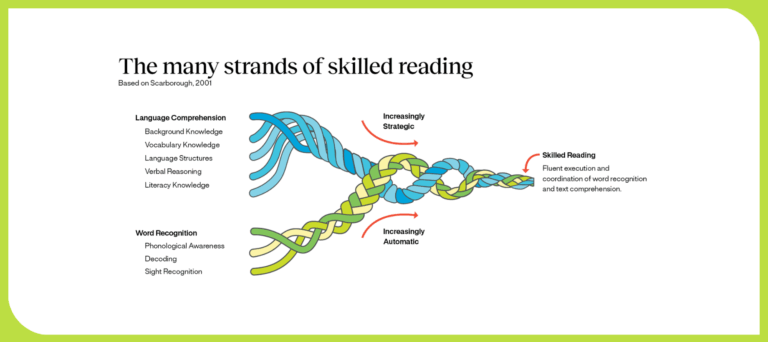
From the science of reading perspective, most screeners and diagnostics focus on the word recognition strand of Scarborough’s Reading Rope, where 70-80% of students with reading difficulties struggle. Screeners and diagnostics focus on the word recognition skills because these are the early skills that must be mastered, and most readers who struggle show deficits in these foundational areas (Moats, L, & Tolman, C., 2009).
Diagnostic tools like 95 PSI and 95 PASI assess similar foundational skills because research consistently identifies these as critical for reading success.
Assessment supports the science of reading by facilitating precise intervention based on individual student needs—ensuring that instruction targets the specific skills each student requires for reading success.
How 95 Percent Group supports effective assessment
95 Percent Group™ integrates and embeds assessment as a core component across all literacy products, providing educators with seamless tools for monitoring progress and adjusting instruction.
Program assessments:
- Weekly spelling assessments provide formative data on student progress
- End of unit assessments administered every few lessons track skill mastery
- Assessment guides help teachers analyze data for differentiation and small group instruction
Intervention assessments:
- 95 PASI assesses phonemic awareness and letter sounds, connecting directly to 95 Phonemic Awareness Intervention Resource™ (95 PAIR)
- 95 PSI maps directly to 95 Phonics Lesson Library (both now embedded in 95 Tier 2 Phonics Solution)
- Comprehensive assessment tools are built into digital practice products like Sortegories® by 95 Percent Group and Tier 3 Literacy Solution, featuring 95 RAP™ (Reading Achievement Program™)— a teacher-led, digital intervention platform.
- Progress monitoring rubrics are integrated into 95 Comprehension 3-6™—reading comprehension intervention for grades 3-6.
Comprehensive Solutions:
95 Literacy Intervention System™ is a comprehensive end-to-end platform that allows educators to view big-picture school data while drilling down to individual student needs.
Almost every 95 Percent Group product includes built-in assessment features for ongoing monitoring and instructional adjustment, creating a seamless connection between assessment and instruction.
FAQs on diagnostics vs. screeners
Screeners are designed for efficiency, taking just 1-3 minutes per student and administered to all students. Diagnostics require approximately 10 minutes per student but are only given to students identified as at-risk through screening results. Both are typically administered one-on-one for accuracy.
Screeners are designed for efficiency, taking just 1-3 minutes per student and administered to all students. Diagnostics require approximately 10 minutes per student but are only given to students identified as at-risk through screening results. Both are typically administered one-on-one for accuracy.
High-quality screeners should be:
- Quick and easy to administer to all students
- Tied to high-leverage skills identified by research as impacting later reading success
- Developmentally appropriate for the target age group
- Norm-referenced for comparison to national standards
High-quality diagnostics should:
- Dive deep into specific skill areas
- Be criterion-referenced to show mastery of particular skills
- Provide actionable data that directly informs intervention planning
- Connect to available intervention resources
High-quality screeners should be:
- Quick and easy to administer to all students
- Tied to high-leverage skills identified by research as impacting later reading success
- Developmentally appropriate for the target age group
- Norm-referenced for comparison to national standards
High-quality diagnostics should:
- Dive deep into specific skill areas
- Be criterion-referenced to show mastery of particular skills
- Provide actionable data that directly informs intervention planning
- Connect to available intervention resources
Diagnostic data should identify specific skill gaps and intervention should be directly tied to these identified deficits. Students should be grouped by similar skill needs rather than general reading levels.
For example, students who struggle with short vowel sounds in Consonant-Vowel-Consonant (CVC) words should be grouped together for targeted phonics intervention, while students with phonemic awareness deficits need different instructional approaches. This targeted grouping ensures that intervention time is used efficiently and effectively to meet all students where they are.
Diagnostic data should identify specific skill gaps and intervention should be directly tied to these identified deficits. Students should be grouped by similar skill needs rather than general reading levels.
For example, students who struggle with short vowel sounds in Consonant-Vowel-Consonant (CVC) words should be grouped together for targeted phonics intervention, while students with phonemic awareness deficits need different instructional approaches. This targeted grouping ensures that intervention time is used efficiently and effectively to meet all students where they are.

Expert biography
Jennifer Delano-Gemzik, EdD has worked in education for the past 25 years as a National ELA consultant and trainer for schools and districts on topics related to the science of reading and implementing evidence-aligned instruction. Before joining the 95 Percent Group, Gemzik worked as a national ELA consultant for the Consortium on Reaching Excellence, a National LETRS facilitator, and as a private consultant. She is a North Carolina state-certified trainer for Reading Research to Classroom Practice as well as a Dyslexia Delegate. She has served as a member of North Carolina’s ELA Advisory Committee, and as a proud parent of two children with special needs, she has volunteered with a state parent advisory group to advance literacy legislation in the state. She has also worked as an elementary school administrator, literacy coach, classroom teacher, and English as a Second Language teacher in North Carolina and overseas with the Peace Corps.
Sources
- Moats, Louisa C., and Carol A. Tolman. LETRS: Language Essentials for Teachers of Reading and Spelling, Vol. 1: Units 1-4. 3rd ed. Voyager Sopris Learning, 2019.