What is phonics? The ultimate guide for educators
Learn why phonics is critical for reading success. Explore evidence-based strategies, teaching methods for all ages, and how to implement effective phonics instruction aligned with the science of reading.

Educator enthusiasm for phonics has waxed and waned over the years. However, decades of research, known as the science of reading, confirms that when teachers employ phonics instruction, 95 percent of children can learn to read. While the teaching of phonics does not stand alone in terms of critical components of early literacy acquisition, in this guide, we will be delving deep into why explicit phonics instruction is so important— exploring its definition, significance, and effective teaching strategies across various age groups.
Let’s begin.
Phonics defined
Phonics is the method of teaching reading, writing and spelling by correlating sounds with symbols—specifically the relationship between sounds (phonemes) and their corresponding letters or letter combinations (graphemes). It encompasses the alphabetic principle: the understanding that letters represent sounds, forming the foundation of decoding written language.
So why is this important? When children are taught that graphemes represent sounds in spoken language, and that they can identify words based on the way letters are put together, they never have to guess what a word says. Students never have to depend on the pictures in a book, looking at the context clues, or whether or not they have memorized a word—these are “strategies” that weaken as they advance to more complex text.
Once a student understands what each letter or letter pattern represents, and all the different possibilities within, they’ve cracked the code to access everything they could ever want to read.
The sounds of language (phonemes)
Phonics instruction revolves around mastering the alphabetic code, and part of that involves understanding phonemes, the smallest units of sound in spoken language. This includes grasping the distinctions between consonants (like /b/ in “bat”), short vowels (like /a/ in “cat”), long vowels (like /ā/ in “cake” along with other sounds the letter “a” represents—for example /o/ like “wall” or /ə/ like “alike”), vowel diphthongs like /oy/ in “toy” and /ow/ in “cow,” and blends (like /bl/ in “black”). A thorough grasp of these sound patterns is essential for proficient reading, writing and spelling.
Mastering phonics means grasping the distinctions between the following:
- consonants: /b/ in “bat”
- short vowels: /a/ in “cat”
- long vowels: /a/ in “cake”. /o/ in “wall”, /e/ in “alike”
- vowel diphtongs: /oy/ in “oy”, /ow/ in “cow”
- blends: /bl/ in “black”
A thorough grasp of these sound patterns is essential for proficient reading, writing and spelling.
When children are taught ineffective strategies that encourage them to guess whole words, they miss the opportunity to break words apart and identify each individual sound. Once children can identify different phoneme patterns and effectively associate them with the correct symbols (graphemes), as well as understand and identify the different types of syllables that make up words, they are capable of reading large, multisyllable words with greater ease and comprehension.
The print component (graphemes)
Solid familiarity with the visual shapes of individual letters is an absolute prerequisite for learning to read. Writing aids letter recognition, the most reliable predictor of future reading success.
Marilyn Jager Adams
Graphemes, or the written symbols that represent a sound (phoneme), are a critical part of phonics instruction. In 2008, the National Early Literacy Panel reported that learning letter names was the #1 predictor of future reading success. Recent research has noted that knowledge of the alphabetic principle (understanding that spoken sounds can be mapped onto printed letters) is one of best indicators that a student will learn to read with ease. Combining letter writing with phonics instruction is an effective way to help children quickly learn and master the sound-symbol association that helps to make reading acquisition easier.
When children practice letter formation in tandem with grapheme-phoneme relationships, they better process, retain, and automatize this information.
One way to do this is to include letter formation instruction each time you introduce a new sound-symbol connection. Our 95 Phonics Core Program® introduces new phonemes at the same time as corresponding graphemes, providing a chance to practice them together.
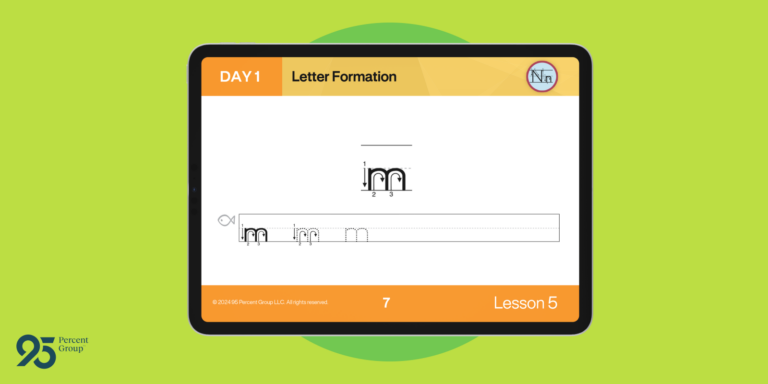

There is a lot of research around the importance of letter formation in securing the alphabetic principle. While oftentimes, teachers are not intentionally teaching letter writing, in fact each letter has its own unique formation, which matters and helps in the overall understanding of the alphabetic principle.
Laura Stewart
Why is phonics important?
Strong phonics skills lay the groundwork for fluent reading and comprehension, empowering learners to tackle increasingly complex texts with confidence. From decoding and unlocking the meaning of unfamiliar words, to more sophisticated spelling patterns, word study and morphology lessons, phonics proficiency is a key to unlocking academic success across all subject areas and all age groups. Reading is truly the gateway and often the gatekeeper to all other success; in school and otherwise.
Teaching phonics by age group
Each grade, age and stage presents unique challenges and opportunities for phonics instruction. While all students are unique and develop at different paces, the instructional components needed to achieve skill fluency are the same. That said, it’s helpful to understand how each group typically learns in the best case scenario, and what skills along the continuum we can expect students to master as age appropriate. Here we will explore and explain strategies for different stages of literacy acquisition and intervention: preschoolers, early elementary students, and upper elementary learners.
Preschool phonics strategies
In the preschool years, phonics instruction runs alongside fostering phonological awareness through playful activities. Students will begin to demonstrate that they have an understanding of how the large structure of spoken language works. Teachers can easily engage them in learning the sounds that letters represent with fun activities like rhyming games, letter-sound matching exercises, interactive storytelling and read aloud sessions. Incorporating songs, rhythm components and fingerplays can make learning phonics a joyous adventure using a speech to print approach.
Since this is a “reading readiness” phase, it’s important that children have the opportunity to play with language, rather than learning in a purely academic approach.
Here are some specific phonics activities you can try:
- Beating the syllables of a child’s name on a drum
- Singing rhyming songs and asking children to put their thumb up when they hear words that rhyme
- Saying a letter and it’s sound and asking a child to find an object that starts with that sound
- Going through the alphabet and naming each letter, it’s sound and something that begins with that sound (“A-/a/-apple, B-/b/-”boy” etc)
Here are some additional phonemic awareness activities if needed!
Kindergarten & early elementary phonics strategies
The bulk of the foundational phonics instruction happens as students progress into kindergarten and early elementary school. This is where direct, structured and systematic phonics instruction becomes critical to reading success. A hallmark of phonics instruction should be providing explicit, repeatable routines in each of the important components of phonics instruction, including:
- Word sorting
- Sound-spelling mapping with and without phonics chips or other manipulatives
- Word chains
- Transfer of skills to accessible text
- Phoneme-grapheme mapping, including writing letters while saying the sound each represents
- High-frequency word practice throughout the grades
- Many opportunities for practice with accessible decodable texts
The most effective phonics instruction is teacher-directed, and hands-on, with multiple opportunities for independent practice and reinforcement. In these early elementary grades, phonics instruction should be cohesive and continual—offering students a spiral staircase of review while adding new concepts each year. If possible, using the same phonics program from year to year in the early elementary grades and beyond offers consistency and the opportunity for students to know one routine; freeing up their cognitive bandwidth and giving them a greater chance to engage with text more meaningfully.
Here are some instructional strategies to try:
- Finger stretching: using the fingers of one hand to tap the thumb from left to right in order to help correctly map the sounds in a word
- Sound mapping with chips or manipulatives: students move a chip into a box for each sound in a word, putting the sounds together
- Arm blending: students use one hand to tap out sounds on the other arm, and then sweep down the arm as they blend sounds together to form a word
- Writing and rewriting words while they say the sounds inside of each word
- Repeated readings of their own writing
- Repeated readings of accessible decodable texts
When students are in kindergarten, teachers should be able to see with a quick assessment whether they are grasping these concepts or whether a student might need more support.
Upper elementary phonics strategies
In upper elementary grades (grades 4 & 5), the focus shifts towards refining and securing phonics patterns and applying them in more complex and academically focused contexts. Students should be working on a word study approach including understanding the six syllable types in both single and multisyllable words, and a study of morphemes while teachers also emphasize continued and robust vocabulary development and reading comprehension strategies using connected grade level texts.
Students should study morphemes along with the six syllable types in single and multisyllable words. At the same time, teachers should emphasize vocabulary development and reading comprehension strategies using connected grade-level texts. You can also incorporate word games, spelling challenges, and literature circles to keep students engaged and motivated.
Here are some instructional strategies to try:
- Graphic organizers to help students engage with and understand the six syllable types
- Games where students have to think of words that fit under each syllable type or have to play charades to have others guess which syllable type they are
- Have students mark up their text to identify words of specific syllable types as they read
Engaging phonics activities
Research tells us that structured and explicit direct phonics instruction is the most effective way to teach all children to read. But experience tells us that supplementing traditional instruction with engaging phonics activities—especially activities that can be done at home—helps to reinforce learning, build confidence, and spark enthusiasm for literacy in general.
From word bingo to phonics scavenger hunts, these hands-on experiences can help to deepen understanding and retention of concepts from simple to more complex.
Phonics and fluency
Phonics proficiency is a critical building block for overall reading fluency, the ability to read with accuracy, appropriate rate, and expression. In order for students to build fluency in decoding, they have to get to a point of automaticity when it comes to sound-symbol association. This requires explicit instruction and many opportunities for students to practice independently while receiving quick and actionable feedback. Integrate fluency-building activities into phonics lessons, such as timed readings, echo reading, and choral reading. Activities like Readers Theatre allow students practice repeated readings to hone oral reading and fluency skills. At the same time, students get to work toward a shared goal while having fun.
Assessment and support
While ensuring that all students have access to structured and explicit phonics instruction can drastically decrease the need for additional reading support, there will be students who need some additional instruction to ensure they have mastered the most critical literacy skills. Once all students are engaged in a curriculum that is aligned with the science of reading and proven to work with actual students, teachers can and should assess students to have a full understanding of their needs to progress toward the ultimate goal of grade-level reading.
A phonics assessment can offer teachers not only insight into what their students need individually, but can also map directly to a proven phonics intervention program to quickly close phonics skill gaps.
Unlocking literacy success through phonics instruction
Phonics instruction lays the groundwork and empowers learners of all ages to unlock the wonders of the written word. By implementing effective systematic instruction, targeted strategies, and engaging activities, educators can instill and nurture strong phonics skills and pave the way for a lifelong love of reading. Explore our range of Tier 1, Tier 2 and Tier 3 phonics resources to embark on this enriching journey with your students.
Strengthen your core literacy instruction
Are you looking for a new language arts curriculum and wondering about phonics instruction? Are too many of your students in need of intervention? Follow the science of reading and discover why the evidence-based supplement 95 Phonics Core Program® is critical to your literacy toolkit (and student progress).
Resources
- Basics: Alphabet Knowledge | Reading Rockets. (n.d.). Reading Rockets. https://www.readingrockets.org/reading-101/reading-and-writing-basics/alphabet-knowledge
- Kang, E. Y., & Shin, M. (2019). The Contributions of Reading Fluency and Decoding to Reading Comprehension for Struggling Readers in the Fourth Grade. Reading & writing quarterly : overcoming learning difficulties, 35(3), 179–192. https://doi.org/10.1080/10573569.2018.1521758
- Pearson, P. D., & Hiebert, E. H. (2010). National Reports in Literacy: Building a Scientific Base for Practice and Policy. Educational Researcher, 39(4), 286-294. https://doi.org/10.3102/0013189X10370205
- The Reading League. (2024, April, 23). Science of Reading: Defining Guide. https://www.thereadingleague.org/what-is-thescience-of-reading/