Spotlight South Dakota: Transforming literacy instruction through teacher-led change
In South Dakota, teacher‑led change is transforming literacy instruction by empowering educators to drive continuous improvement and strengthen outcomes for learners. With intentional support and collaborative leadership, this approach is building more effective, sustainable reading instruction across classrooms.

District snapshot
- Located in southeast South Dakota
- 2700 students in grades K-12
- 8% Native American students
- 10% Hispanic
- 40% free and reduced
- 20% Special Ed.
- Products used: 95 Phonics Core Program, 95 Phonics Lesson Library, 95 Phonemic Awareness Intervention Resource (PAIR), One 95 Platform for data collection
Sarah Timmer stepped into her role as Mitchell School District’s K-12 Curriculum Director right in the middle of an ELA curriculum review. “I knew the science of reading was gaining traction in South Dakota, so I really spent the summer wrapping my head around everything.” Although she was nervous about where to begin with her elementary teachers, she knew the curriculum was missing foundational skills instruction.
“We needed the bottom of the reading rope,” Timmer acknowledged. “We knew we had gaps in decoding and encoding.”
But her faculty was divided: half were ready to move toward structured literacy—instruction backed by the science of reading. And the other half were still partial to their balanced literacy approach—with certain components they had been teaching with for a long time. So Timmer did what she felt would at least start a conversation. A gallery walk exercise.
Questions reveal priorities
Timmer stood in the meeting room watching teachers move between posters labeled with different aspects of structured literacy, each armed with sticky notes—not realizing she was about to discover one of her most valuable leadership tools.
As teachers wrote their questions, concerns, and ideas, a clear pattern emerged—one that would shape her entire implementation strategy. At the Scope and Sequence poster for example, they posed sophisticated theoretical questions about curriculum alignment, but when they moved to Explicit Phonics Instruction, their sticky notes revealed vulnerability with statements like “Changing to a new style teaching phonics is challenging” along with requests for ongoing training support. On the Tiered System poster teachers’ contributions became confident and declarative about the need for consistency.
Those simple sticky notes, which Timmer preserved for two years, became her roadmap for slowing down the curriculum adoption timeline and providing targeted support where teachers needed it most, proving that listening to the questions teachers ask—rather than the answers they think they should give—reveals their true priorities and concerns in ways that simply making assumptions can’t. And when they found 95 Percent Group’s Tier 1 Phonics Solution, it was an obvious match.
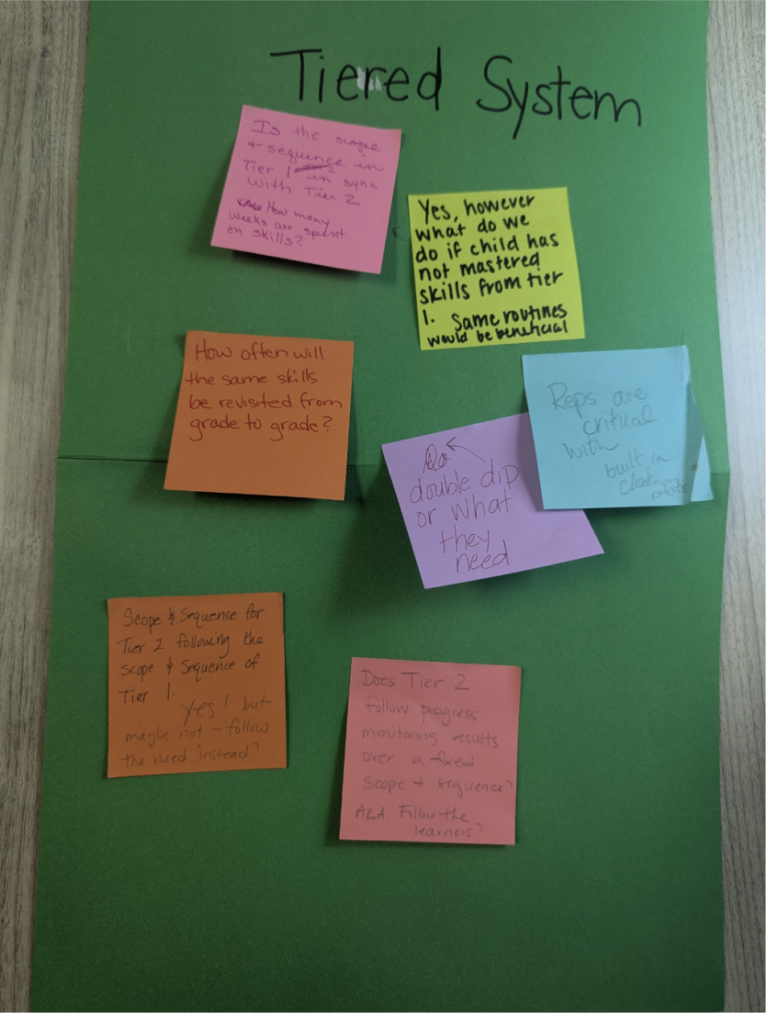
Timmer couldn’t throw away the tool that helped her teachers come to a thoughtful conclusion about what was missing in their literacy instruction.
Interested in learning more about Timmer’s thoughtful approach to this process? Check out her strategy here!
A supported implementation
Once Timmer could see where her teacher’s priorities and concerns were, she was able to land on a resource for part 1 of their curriculum reboot: explicit phonics instruction. With a clear understanding of what teachers and administrators felt was important, almost everyone chose 95 Phonics Core Program® out of the three programs they had selected for review. With her teachers’ clearly expressed needs in mind, Timmer hired a literacy coach at each elementary campus to support the transition, and have become an integral part of their success.
Power up your practice
The coaches, Amanda Hargreaves, Amanda Sonne, and Megan McManus are in classrooms all week long. They support both Tier 1 instruction and lead the “all-hands-on-deck” approach that Mitchell School District is taking for Tier 2 intervention.
Although the three women didn’t know each other at the beginning of the school year, it’s clear they now work as a united team—focused on literacy growth. One of the components they attribute their growth to this year is the data cycles they’ve implemented this year (8 cycles throughout the year—so students really have a chance to learn and grow) and the different ways they’ve helped to instill a sense of community, support, and learning from one another amongst teachers, and even among the three elementary schools. “We went to a Jim Knight training with just the coaches and myself, and really talked a lot about how to measure engagement and student participation: for example, what are the different opportunities for response? Are we getting choral responses?” Timmer explained.
After teachers had had some time with the materials, they started filming brief instructional moments that really showed how teachers were instructing on different explicit phonics skills, and also how students were responding. They called these “Power-up Your Practice” and would send them out weekly to all teachers. “It was all in an effort to help everyone see what was possible and to truly beef up our Tier 1 instruction this year.”
Numbers that tell a story
The data from Mitchell School District’s first year with 95 Phonics Core Program speaks for itself, but behind every statistic is a student whose reading journey was transformed.
District-wide growth
Second grade as a whole gained an average of 95 Phonics Screener for Intervention (PSI) levels per student—a remarkable leap that demonstrates the power of consistent, systematic phonics instruction across an entire grade level. But the individual stories within that data reveal the true impact.
Confidence beyond fluency:
A quiet second-grade English language learner started the year off reading just 36 words per minute. With Tier 2 intervention instruction, she finished the year at 86 words per minute—more than doubling her reading speed. Even more striking was her transformation in the classroom: “She was raising her hand like crazy,” McManus said, smiling. “In other subject areas she was participating during the entire lessons as well. You could hear her voice louder than the other children in her class.”
Breaking through barriers:
A fifth-grade student—who had been evaluated for special education but didn’t qualify—had been stuck at the lowest reading levels. Starting in Tier 2 intervention, he gained 46 words per minute while mastering specific phonics skills, and began arriving at school each day with much more confidence. His growth proved that with explicit, evidence-based instruction, students previously considered “stuck” could make dramatic gains.
First Grade Milestone:
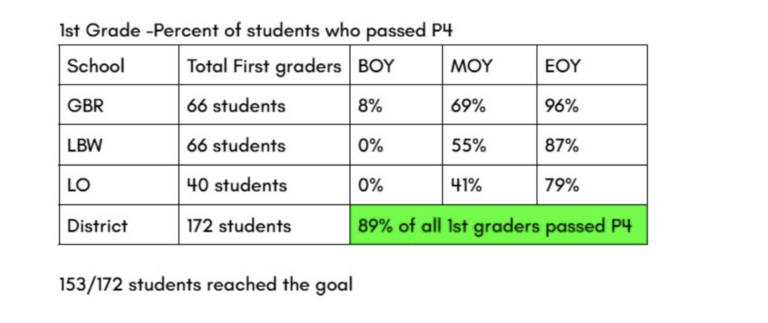
The 1st grade team had an ambitious goal for the year: for all first graders to reach proficiency at the Phonics Screener for Intervention skill level P4 by year’s end. The results exceeded expectations—with a 96% proficiency rate across all first grade students at one elementary school, including English language learners and students receiving intervention support. The district-wide success of 89% demonstrates that when systematic phonics instruction is implemented with integrity, virtually every student can achieve grade-level reading milestones.
Upper elementary success:
Another fifth-grade ELL student began the year reading 85 words per minute—already a solid pace—but gained an additional 56 words per minute by year’s end. This growth demonstrates that structured literacy benefits students at all levels, not just those struggling with foundational skills.
These numbers represent more than reading improvement—they capture students finding their voices, building confidence, and discovering that they are capable readers after all.
One of my second grade teachers has been talking about how their students are carrying these phonics skills into other learning areas. When they weren’t sure how to spell a multisyllabic word, the students pulled the word apart using the syllabication rules. That’s what we hope for, right? So just seeing that carry over was pretty powerful
Amanda Sonne
The teacher shift
It’s not just students that are able to change the way they see themselves with this work. When the district announced they would be moving to a structured literacy approach, roughly half of teachers were unhappy about this change. Adding something completely different to an educator’s plate is a lot—it’s a lot of learning; and for many who were comfortable and familiar with what they had been doing for many years, they were pretty skeptical about the change.
McManus spoke to this idea and the way teacher enthusiasm about working with 95 Phonics Core Program shifted as they began to quickly see their students’ results. “The teachers that maybe didn’t buy into the curriculum at the beginning of the year,” she explains, “are now the same ones who are saying, ‘This is my favorite part of the day! I hate when we have to miss this [phonics instruction].’”
The assessment and data cycle began to reveal specific needs and gaps in learning. This prompted teachers to more easily see why they needed to stick with this explicit instruction and truly make sure they are implementing it with integrity.
Hargreaves spoke to this idea. “We’ve had some great lightbulb moments for teachers. They’ll have students who seem like pretty strong readers, but they’re missing just one foundational skill—like long vowel-silent E, for example. When we get those students into a targeted group for three weeks, they master that one concept, and then they absolutely soar. It was like that one skill was the missing piece holding them back from being truly fluent readers,” she continued. “Once they have it, they’re cruising through vowel teams and all those advanced phonics patterns. Sometimes it’s just finding that one little gap that can push a student forward dramatically.”
Those who were hesitant about a scripted curriculum could quickly see the benefit not only for the students, but for the way they could be more present with their students.
Teachers realized quickly that by using a script, it freed them up to be able to see what students were doing. To see their faces and to better know who was getting it and who was waiting around for someone else to say the answer.
Megan McManus
Looking ahead: Building on a strong Foundation
As Mitchell School District prepares for year two of their structured literacy journey, the foundation they’ve built is already paying dividends. Teachers are excited to welcome students who already know the routines and language of systematic phonics instruction—no more starting from scratch or teaching procedures alongside content.
The end-of-year data has become their roadmap for the future, allowing educators to identify exactly which students need targeted intervention from day one. “We have data now from the end of the year, and we know who we need to target with help right away,” Sonne says excitedly. This type of precision means no student will slip through the cracks upon returning to school.
The transformation that began with sticky notes and some skeptical teachers has evolved into a district-wide commitment to evidence-based reading instruction. When asked what they would offer as advice to others just beginning this structured literacy journey, they kind of laughed. “It sounds cliche,” Sonne offered, “but really just to trust the process. It takes some time and effort to adjust to a different approach. We’ve really had to embrace the productive struggle.”
“And truly to take an ‘all hands on deck’ mentality,” Hargreaves adds. “It’s truly changed the way we operate and support our students with skill gaps.”
With strong data, truly dedicated educators, and students who are already fluent in the language of structured literacy, it’s clear that Mitchell School District is positioned not just to sustain their gains, but to accelerate them—and, so far, the results speak for themselves.

Share this success story
See how Mitchell School District built lasting literacy change through teacher-led implementation, literacy coaching, and evidence-based instruction. Download and share the full customer story to share with district leaders, literacy teams, school administrators, and instructional coaches.