Spotlight West Virginia: A transformation strategy + commitment = stunning success
How does a small elementary school in rural West Virginia go from being one of lowest to one of the highest performing schools in the state in five years (with a pandemic in the middle)? The successful transformation of Smithville Elementary School and the vision of Smithville’s committed school leaders have inspired the two other elementary schools and middle school in the county to aim high and do the same, ensuring every student arrives at Ritchie County High School prepared to succeed in their education and life.

Ritchie County Snapshot
- White 99.1%
- Economically
- Disadvantaged 47%
- Special Education 22%
- English Learners < 1%
Ritchie County is located in northwestern West Virginia, about 25 miles from the southeastern Ohio border at the closest point. It is home to a small population—currently around 8000 and dropping—spread out over a very large landmass of 454 square miles. Out of 55 counties, Ritchie County is the 51st most sparsely populated. It has the 7th highest poverty rate in the state, with 14.8% of the population in poverty (July 1, 2015 census) and closer to 24.5% for children in poverty. Employment opportunities are few and far between, and many homes have multiple families living under one roof.
Despite the unique challenges in the county, leadership and teachers are not letting anything get in the way of making sure every student gets the support needed to succeed. Their dedication and commitment is working to transform the district and transform lives.
Smithville Elementary School is the smallest of three elementary schools with a total enrollment of only 70 students in preK-4. Harrisville Elementary School and Creed Collins Elementary School have approximately 120 students enrolled in each. Ritchie County Middle School serves all three elementary schools and has approximately 320 students in grades 5-8. All of these schools feed into Ritchie County High School with approximately 328 students in grades 9-12.
Facing hard challenges head on
The town of Smithville is small enough that everyone knows everyone. But we can’t have any preconceived notions about kids because we know their family or things like that. None of that matters. It’s just this: Okay, you come in. We believe from day one that you can do it. And what do we need to do to help you get there?
Jacob Clevenger
The elementary and middle schools face a number of difficult challenges. The youth foster care population in Ritchie County is high, with a foster care rate 8 times the national average. Chronic absenteeism is another challenge. Initially, the number of students in need of services exceeded their capacity to provide support. The district has a shortage of substitute teachers—they have two substitutes for elementary in the entire district.
With long distances to travel for work and school, getting parents to the schools for engagement activities for their children’s education has historically been very hard which meant that many parents were unaware of what they could do to help their children with the early literacy skills they would need in school. In addition, district schools are experiencing decreased enrollment due to other options that have become available to families—West Virginia has a virtual school and the state has the Hope Scholarship which provides funding to families for private school or home school.
Despite these challenges, a few committed educators in Ritchie County had a vision that they could turn their low-performing schools around to become top performers in the state. They understood the lifelong impacts on students of continuing a downward trend and dove in head first to identify the causes and to implement creative solutions.
A Title 1 director and superintendent as catalysts
The Ritchie County Title 1 Director of Student Services, Debbie Bever, gets a lot of credit for providing a range of science-of-reading programs from 95 Percent Group to the elementary schools in 2018. Professional learning consultant and coach from 95 Percent Group, Jennifer Delano-Gemzik, explains that Bever was very on board with coaching. When Jim Brown came on as a new superintendent in 2019, he brought the vision to support the schools in using their new resources effectively. But it took the collaboration of two educators at Smithville Elementary to achieve lift off.
Determined leadership with a clear vision
Casey Kerns became principal of Smithville Elementary in 2012. Jacob Clevenger arrived in 2022-23, leaving his position as assistant principal at the middle school to take on the role of Chief Instructional Leader in the district. Kerns and Clevenger both have children in the district. As they started working closely together, they asked themselves what kind of schools they wanted for their own children and knew that what they wanted for their children is what all children in Ritchie County need. And they knew they had to and could turn Smithville around from one of the lowest ranking schools—not just to improve their ranking but to excel in the state.
The school initially purchased 95 Phonics Lesson Library™ in 2018 to provide Tier 2 intervention for students and started training staff with the goal of fully implementing in the 2019-2020 school year. The COVID pandemic dramatically disrupted those plans. Instead, in the 2020-2021 school year, Smithville had to put in place a split hybrid model with some students at home and some students in school.
On the other side of the pandemic, Kerns and Clevenger picked up their plans to do a full implementation of 95 Phonics Lesson Library and train everyone—teachers in all subject areas, instructional aides, substitutes. As Clevenger describes it, “2022-23 was really the first year of all hands on deck.” He continues, “Thanks to Jennifer Delano-Gemzik, our professional learning consultant and coach from 95 Percent Group, I’ve learned right alongside the teachers how this process should work.”

I’ve worked with other counties in West Virginia and I can honestly say with Ritchie County School District, they are truly something special. You do not get districts like them. And I think it’s because they’re so secluded that they know no one else is coming. No one else is going to do this work. They understand: ‘If we don’t do it, then who else is going to do it? There isn’t anyone that’s going to come and do it for us. We have to do it.’
Jennifer Delano-Gemzik, EdD
A no excuses, solution-oriented approach
Smithville Elementary
When Casey Kerns became principal of Smithville Elementary, the staff began implementing a schoolwide Walk-to-Intervention model using 95 Phonics Lesson Library with 95 Phonemic Awareness Screener for Intervention™ (PASI), and 95 Phonics Screener for Intervention™ (PSI). They added 95 Reading Achievement Program (95 RAP™) for Tier 3 intervention in 2024.
According to 95 Percent Group professional learning consultant Jennifer Delano-Gemzik, “Casey herself led one of the intervention groups. She and her teachers relentlessly pore over every piece of data collected to determine who is and is not making progress. With a no excuses, solution-oriented approach, students not making adequate progress immediately have additional tiers of support put in place. Through the adoption of 95 RAP and 95 Literacy Intervention System™, the staff carefully monitors instruction and makes immediate adjustments as needed. Failure is not an option. In just a few short years, Smithville has rocketed to the top performing school in the state and has proudly held this honor for five years in a row now.”
Clevenger explains that within the past couple of years, since he has been at Smithville, they have also added 95 Phonemic Awareness Intervention Resource™ (PAIR) for Tier 2 and 95 Pocket PA™ for Tier 1 phonemic awareness instruction as well. He reports that next year will be their first year adding in the 95 Phonics Core Program®. It became clear that their existing Tier 1 phonics program wasn’t doing what it should be doing.
Clevenger shares his expectation for implementing 95 Phonics Core Program for Tier 1 next year: “We work really hard intervention-wise to dig ourselves out of holes that we won’t create now. I’m very confident that we will see a huge difference for kids when that terminology is consistent all the way through. In the future, we expect that interventions may be very quick, not something that stretches over a year or two for a student.”
Harrisville Elementary School
Principal Laura Snodgrass catalyzed a literacy revamp at Harrisville in 2024-2025. Jennifer Delano-Gemzik describes the changes implemented in the revamp: “They were not consistently using their universal screener to determine who needed to be assessed with their diagnostic assessment, 95 PSI. Laura pushed them to consistently assess every student that scored low on the universal screener with PSI and to then place that student in the corresponding intervention group. In addition, she had teachers begin implementing a schedule for routine progress monitoring to ensure that skills taught in intervention were being carried over. With the literacy revamp, Laura had them use the assessments more strategically and with integrity to ensure accurate decision making about student needs and growth.”
Delano-Gemzik explained how before the revamp, the school was using a replacement model. The processes Principal Snodgrass put in place shifted the school to an additive model instead. She made sure that every student was getting an opportunity to receive intervention wherever they were: in Tier 1, in Tier 2 with 95 Phonics Lesson Library, and in Tier 3 with 95 RAP (each now part of 95 Tier 2 Phonics Solution and 95 Tier 3 Literacy Solution respectively).
In addition, Snodgrass added an additional Title 1 interventionist. Then the two interventionists could push into the reading block during small group time and offer extra support for any students that needed it, with the idea that they might just need some extra Tier 1 work. In addition, they implemented Walk-to-Intervention time in the schedule for the interventionists to work with students who needed Tier 2 or Tier 3 support.
In the second half of the 2024-2025 year, Clevenger started working with Harrisville principal Laura Snodgrass. “Once we put these new procedures in place, things took off. Harrisville had gone from being ranked 221st of 373 like schools in 2023, to 69th in 2025.”
Creed Collins Elementary School
While Harrisville was moving ahead, Clevenger worked with Creed Collins to revamp their entire schedule. “It’s basically like a Walk-to-Intervention model in the morning for an hour and a half but it includes core phonics instruction, small group phonics instruction, and intervention.” He explains that they are doing this in K-2. This enables students—whether they are ready to advance or they need intervention—to get that extra support.
Then later in the day, any students who are further behind additionally get Tier 3 support with 95 RAP. Clevenger expands, “We have a WIN (What I Need) time built into that as well, which, for some students, ends up being more phonics instruction or additional practice—whatever they need. These kids are now getting two hours a day. And I think we all know, and research shows, that it’s not that they need something different, they just need more of it.” They brought in a retired kindergarten teacher from Harrisville to use the 95 interventions one-on-one with about 10 students. Clevenger shares that all of those kids have shown tremendous growth.
This schedule redesign went so well at Creed Collins, they are circling back to Harrisville to do the same thing there this coming year. In the 2026-2027 school year, Harrisville will have a new principal as Snodgrass has moved to a new school. 95 Percent Group’s Jennifer Delano-Gemzik will work closely with the new Harrisville principal to make sure they continue in the same direction with what they’ve started. Delano-Gemzik will also be working closely with Creed Collins to help them get to where the other two schools are headed.
Clevenger is excited that Creed Collins will have a full-time literacy coach in the year ahead, in addition to 95 Phonics Core Program. “I think that it will be a much different trajectory than what it has been in the past. The person that took that position was actually a first grade teacher there already—she has an understanding of the way the school works and the makeup of the staff so I think she’ll do a very good job in that position.”
He continued, “And of course we’ll have Jennifer come back to work with her and support her in those ways, but Jennifer’s main focus will be making sure that that core curriculum is implemented the right way, that we’re following up on that, getting interventions in place immediately, and when we know there are issues, fixing them right away so they don’t become harder to fix later on.”
Ritchie County Middle School
Ritchie County Middle School is getting a strategy and schedule revamp as well. Clevenger explains, “In the past, they would do interventions on different reading comprehension strategies or writing. But we know that the kids that need those interventions are kids that still need help with foundational reading skills.” Based on this understanding, they are adding 95 Phonics Lesson Library and repurposing time that was spent doing intervention on reading comprehension and writing to the foundational reading skills instruction and practice these students need.
Clevenger continues, “This approach will serve about seven to ten students per grade level, not many, to get those kids that we know are in the greatest risk category caught up in their reading skills. That way then they can be successful in other areas.”
Clevenger emphasizes how the work they’ve been doing in the elementary schools has dramatically reduced the number of students coming into the middle school still needing foundational reading skills intervention. This is their primary goal and they are achieving it.
“Today we have such a small number of kids that are getting through elementary school without those foundational reading skills. Ten years ago we couldn’t have done it because it would have been half the class, right? Now that we have it niched down to only 10% to 15% of kids in each grade level, we can target those kids and continue to catch them up until we have them where they need to be, and particularly regarding high school, have next to zero kids going to high school without foundational reading skills.”
Layers upon layers
Clevenger mentions what the reality in many counties was when he stepped into his role of Chief Instructional Leader in the district—if they could provide intervention three days for 30 minutes a week, that would be good. He compares their approach today: “We’re doing 30 minutes every single day. And some of these kids, not only are they getting that, but they’re also getting 95 RAP, the heart of 95 Tier 3 Literacy Solution, on top of that. And so we have kids getting an hour a day. And when we’re able to add the core, we’ll have kids getting an hour and a half a day. They just keep getting services layered and layered and layered through that, which I feel has been super, super helpful for them.”
Consistency matters
Tiers 1-3: No one else in the state was doing it
West Virginia has what they call “community of practice meetings.” These are organized by counties and district size. At some point, Clevenger tracked down recordings of the meetings and listened to all of them—he was struck by what he didn’t hear but thought he should have. He explains, “In the whole state, I realized that no one uses something that includes Tier 1, Tier 2, and Tier 3. No matter what the product is, no one seemed to use something consistently all the way through.”
Clevenger is very confident that they can make a big difference for kids when their approach is aligned and consistent all the way through. He emphasizes, “When they’re not worried about the process or a procedure or the language or the terminology, they can just learn.”
The critical mindset shift—data as a tool, not a judgment
Both Clevenger and Delano-Gemzik emphasized the teacher mindset shift that was necessary around data. Delano-Gemzik recounts that when she first started working with the district, in some of the schools, intervention was a means to get a child into SPED, and then they wouldn’t be taught in the core classroom anymore. She continues, “Jake has really been very vulnerable and shown them, look, I’m learning along with you and this is not okay.”
Clevenger talks about the shift: “I think it took a long time of me working with people to help them see that I’m not there to evaluate them. I’m very fortunate. It’s my favorite part about my job. I evaluate no one. I help them to see: ‘I’m here the same way that you’re here. We have the same goal. That goal is to help these kids get to where they need to be.’ Over the four years that I’ve been here, I think there’s been a big shift with people understanding that it isn’t a negative thing because our data looks this way. It’s okay! Now, what do we do to make it better? I think in the long term this approach helps them a lot.”
An especially important outcome of this mindset shift has been on the students in special education. As Clevenger explains, “We’re using data as a tool to help teachers and their students be better. So even with our students in special education, we’re not going to just put a little star by them and not worry about their data because they’re in special education. We’re going to see what they need and we’re going to teach them the same way we teach every other kid.”
He continues, “These students get the same services and then more on top of that. They are going to a special education teacher where they are pre-taught the skills they’ll be learning in class using 95 RAP, and then when they return to their class, they are getting core instruction, and participating in the Phonics Lesson Library with the group. So the learning just keeps getting layered and layered and layered through this approach, which has been super, super helpful for them.”
Seeing tremendous results
We’re working to get everyone bought into the same process—whether they’re a math person or an ELA person—these are the foundational skills that our kids need to have.
Jacob Clevenger
Their dedicated efforts have seen tremendous results this year. Clevenger shared how their approach has been especially significant for students in special education. “For many of these students, their results are quite probably going to meet standards on their end-of-year assessments because they got what they needed. We even found a person to come in and work through 95 RAP with them one-on-one as another layer so some of these students are getting 2 1/2 hours a day of instruction and practice.”
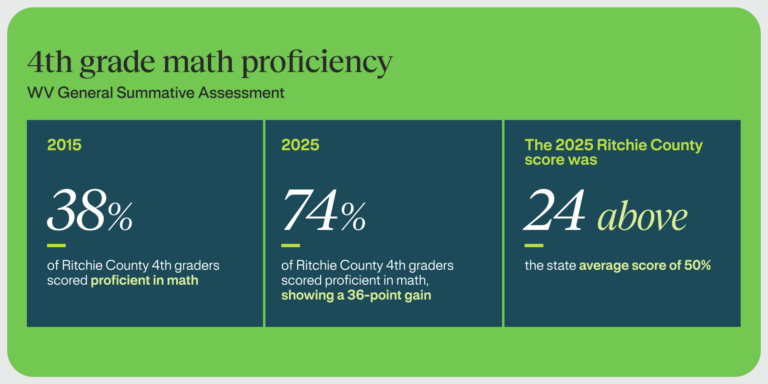
He also described the dramatic change in student math scores, once math teachers understood that students had been failing to understand the words they were asked to read in assessments. He reports, “In the 2025 school year scores for fourth grade math, we were 74% proficient, which for our state is kind of unheard of. We were 10% higher than any other district in the state. But the biggest part for us is the kids can read the word problems now, so it all makes sense. And…it’s not released yet, but this year we’re going to be even higher than we were last year.”
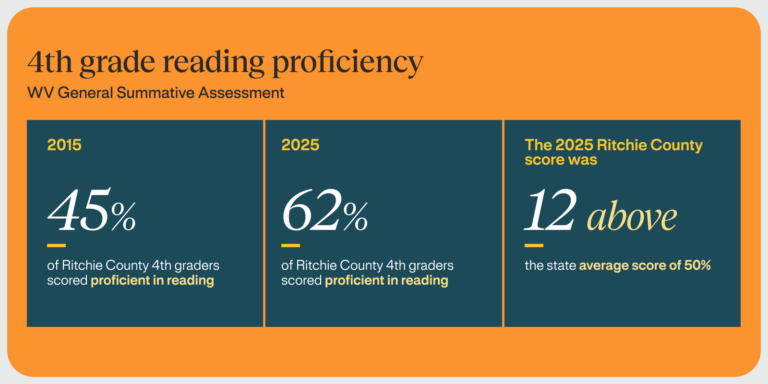
And in reading proficiency, Clevenger reports that in the five years since the COVID low point, the state gained 6 points, while Ritchie County gained 13 points—more than double the state’s rate of improvement.
Looking ahead
To wrap up, Clevenger reiterated how excited he is looking ahead to the 2026-2027 school year.
“I feel very confident that when we begin 95 Phonics Core Program in the coming year, I think we’ll see an immediate boost. It is a long game. We’re trying to prepare teachers for the impacts we expect to see in middle school and high school—‘Hey, you’re going to get these kids and they’re not going to be like kids you’ve had in the past.’ I think 5th grade was the first grade this year where we’ve had teachers letting us know that they can see the kids have changed.”
Clevenger continues, “That’s why I’m so excited about adding the core program next year in kindergarten through 4th grade. Within the first four weeks of kids being in school, we will know what they should know, and If they don’t, we can intervene immediately. Then those gaps that have happened in the past won’t happen. Looking ahead, I think getting that core program and knowing what is possible for kids is what really excites me the most.”
Looking at the recent district reading and math proficiency scores, their powerful commitment and transformation strategy for the district is working.