Closing the gap between knowledge and classroom instruction
Discover why science of reading training is only the beginning. Explore how ongoing professional learning, coaching, and structured support help educators translate research into consistent classroom instruction that improves student outcomes.
When author and literacy consultant, Dr. Deb Glaser, EdD, started working with an elementary school in Wyoming in 2015, it was one of the lowest performing in the state. Teachers did not have reading materials designed to support explicit, systematic instruction, and many had never been taught how to explicitly teach foundational reading skills.
Dr. Glaser’s first step was providing science of reading training.
The following year, she returned to work alongside teachers as they dug into the much harder work of translating new knowledge into daily classroom practice. Teachers were given structured time to examine student data, revisit what they had learned, collaboratively problem-solve, and determine how to respond to the students sitting in front of them. Dr. Glaser modeled instructional techniques in classrooms, while the school’s reading coach maintained the focus between visits.
In other words, teachers weren’t expected to leave the training armed with new knowledge…and then figure out the rest alone.
Over the course of the four years Dr. Glaser was returning to work with educators in Wyoming, this particular school became one of the highest performing schools in the state. Her experience in Wyoming illustrates something districts across the country continue to grapple with: knowledge is essential, but knowledge alone doesn’t automatically translate into consistent classroom practice.
So how can districts and schools move from knowing to doing—and doing successfully—by strengthening their own, in-house expertise?
The missing step between knowing and doing
When districts have invested their time, energy, and money in professional learning in the science of reading, the expectation feels straightforward: teachers gain new knowledge, classroom instruction improves, and student outcomes follow.
But in the reality of daily classroom life, there is often one critical step missing. It’s tempting to view this as a teacher efficacy or effectiveness issue. But that explanation overlooks something fundamental about how people learn and change. Teachers want to do what’s best for their students. They’re invested in their craft and in their students’ success. And: acquiring new knowledge is inherently different from changing instructional practice.
As Dr. Glaser explains, “Teachers have teaching habits…that’s what they’re going to fall back on.” The fact is, the habits that a teacher develops shape her daily instruction because they worked for years with many of her students. The challenge, then, isn’t simply learning the science—it’s learning and internalizing the approaches that will reach even more of her students with stronger, more durable instruction.
Changing practice means changing habits
Think about the last time you tried to change a habit you knew was no longer serving you. You understood the problem. You may have even sought out information about exactly what you needed to do differently. So then…it was easy, right?
Almost certainly not. Because knowing and doing aren’t the same thing. The concept is simple. The practice of it is anything but.
One of the biggest misconceptions surrounding science-of-reading implementation is this assumption: that once teachers understand the research, aligned classroom practice will naturally follow. According to Dr. Glaser, that’s rarely how professional growth works.
Teachers develop routines over years of classroom experience. Those routines become automatic—especially during the countless moment-by-moment instructional decisions teachers make every day.
Rather than expecting teachers to replace years of instructional habits overnight, Glaser recommends linking new practices to existing routines. “For example, if a teacher always provides a warmup before a reading lesson, that routine is in place—so she can implement blending and segmenting phonemes in words that the students will be learning to read.” Lasting change happens one instructional decision at a time—not all at once.
Consistency creates the conditions for learning
Teachers often naturally seek novelty and creativity in their practice. Those elements are an important part of the art of teaching, giving educators space for autonomy, self-expression, and responsiveness to their students.
But when students encounter different routines, instructional language, and approaches from classroom to classroom, across grade levels, or between tiers of instruction, they end up spending valuable cognitive energy simply figuring out what to do and what is expected of them. That is energy that could otherwise be devoted to meaningful learning.
As Dr. Glaser emphasizes, consistency doesn’t limit creativity—it creates the foundation for it. When core instructional routines and language are predictable, both teachers and students are freed to focus on what matters most. Students spend less energy navigating how to learn and more energy on learning itself.
She goes on to explain, “If we are consistent, the new routines in our instruction will become habits. Then we can branch out in more creative ways.”
But establishing those routines requires more than simply telling teachers what consistent, evidence-aligned instruction should look like. Teachers need opportunities to see it, practice it, and refine it—in their classrooms, with their students and with support from peers in structured learning communities.
Professional learning must move beyond workshops
Professional learning is an important starting point—but it was never designed to be the finish line.
Terrie Noland, PhD, CALT
Teachers don’t work in isolation; they work within systems. If Dr. Glaser’s perspective explains why teachers struggle to translate knowledge into practice—literacy leadership mentor and coach, Terrie Noland, PhD, CALT, explains why that struggle often persists.
“Teachers don’t return from professional learning to a blank slate. They return to schedules, curriculum decisions, competing initiatives, and established ways of working that they often have little power to change—all of which can either reinforce or unintentionally undermine the instructional practices they’ve just learned.”
Although she once believed the solution was relatively simple, Noland’s own thinking about professional learning has evolved over time.
“I spent a lifetime doing one-day, or one-off trainings…and the truth is that the science of learning has shown us that people do not learn this way. Building momentum,” she continued, “requires thoughtful planning. It requires thoughtful integration of knowledge.”
Just as students don’t become fluent readers after a single lesson, teachers don’t fundamentally change instructional practice after a single workshop. Sustainable implementation requires repeated opportunities to learn, apply, reflect, receive feedback, collaborate, and refine their practice over time.
The facilitator-teacher relationship: From evaluation to partnership
Dr. Glaser shared an analogy from The Checklist Manifesto, by Atul Gawande, that perfectly illustrates the role of instructional coaching.
In medicine, surgeons already know the correct procedures. Yet outcomes improved dramatically when nurses were empowered to ensure every critical step was consistently followed.
The lesson for education?
Instructional coaches as facilitators aren’t there to replace teacher expertise. They’re there to support consistent implementation. Glaser’s take? “The facilitator is there to ensure that these steps are followed…then the teacher is the one that works their magic.”
That subtle shift transforms the coaching or facilitator relationship from evaluation to partnership.
This was particularly true at the Wyoming elementary school Glaser supported where structured application wasn’t an abstract concept; it was built into the professional learning process. Teachers attended half-day sessions three times a year where they examined student data, interpreted results together, revisited concepts from their initial training, and collaboratively determined how to respond instructionally. They then watched Glaser model those techniques with actual students before returning to their own classrooms to put them into practice.
This created a continuous cycle:
Learn. Reflect. Observe. Apply. Examine the results. Adjust. Repeat.
Most critically, teachers weren’t left to sustain that cycle alone. The school’s reading coach facilitated and maintained the focus between Glaser’s visits, while the principal protected the time and structures that allowed the work to continue.
Leadership creates—and sustains—the conditions for change.
Coaching helps individual teachers build new instructional habits—but it’s leadership that determines whether those habits become part of a school’s culture. For Noland, the role of leadership extends far beyond scheduling professional development or purchasing high-quality instructional materials.
It means intentionally creating the conditions where research-based instruction can take root and flourish. Noland emphasizes that leadership begins with personal growth and development. “The leader should be the lead learner,” she explains. “They’re the lead model of what continual growth looks like.”
That starts with a shift in mindset. Rather than viewing literacy as another initiative to complete, districts need leaders whose daily work centers on moving literacy forward. She goes further.
“You need individuals that wake up every day and think about literacy…someone who knows, ‘this is my focus. This is what I do every single day.’”
When that happens, leaders aren’t simply managing implementation—they’re driving the vision, supporting instructional consistency, and creating the structures that help teachers successfully apply what they’ve learned.
From knowing to doing
The experience in Wyoming demonstrates what can happen when professional learning is treated not as an event, but as an ongoing cycle of knowledge, application, reflection, and support.
But it also raises an important question for district leaders:
How do you create those conditions at scale, without relying on an outside expert to return year after year?
For Brooke Rowe, senior product marketing manager at 95 Percent Group, the answer begins with what has been missing historically in professional learning. “When it comes to science of reading professional learning, there is a lot of focus on knowledge training. But we don’t see as much post-training application support. This is the gap right now that needs bridging for teachers—to have continued learning in a structured, reflective environment so that evidence-aligned strategies and tools can reach the widest range of learners”
Building the bridge from knowledge to practice
Traditional professional learning often succeeds at building understanding. What educators need next is structured support that helps them translate that understanding into daily instructional decisions.
That means moving beyond isolated workshops toward professional learning that unfolds over time through practice, collaboration, reflection, and coaching.
As Rowe explains, teachers need opportunities to continually ask themselves:
“What’s the one thing I can do differently tomorrow that will change instruction, and impact my students in positive ways?”
Rather than expecting educators to absorb everything in a single training, the goal is to create a cycle of learning and application—what both Noland and Glaser describe as the bridge between knowledge and practice.
95 Percent Group designed 95 Principles to Practice™—Literacy around that exact philosophy.
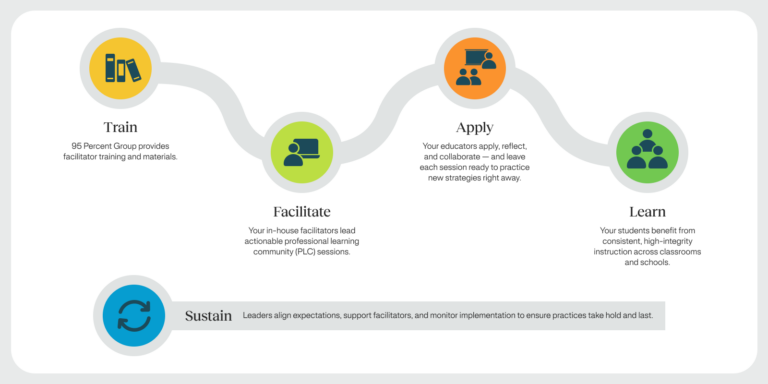
95 Principles to Practice is a post-training support system, giving structure and guidance to ongoing professional learning communities (PLCs) where trained, in-house facilitators help educators revisit key concepts, collaborate with peers, apply new instructional practices, and receive structured support over time.
Each role within the system—teachers, facilitators, instructional leaders, and administrators—has dedicated resources designed specifically for the decisions they make every day:
- Teachers receive learning companions that help them identify practical next steps—all supported by a community of their peers inside structured PLCs
- Facilitators receive a Facilitator’s Guide, and Facilitator Presentation Files along with a specially designed training so they can guide collaborative learning.
- Leaders gain implementation supports, including instructional look-fors and monitoring tools that help sustain consistent practice across any science-of-reading aligned classroom
That intentional design reflects one of Noland’s central beliefs about effective professional learning: “Know a little. Do a little. Know a little more. Do a little more.”
Rather than viewing professional learning as a one-time event, 95 Principles to Practice—Literacy supports the gradual development of instructional expertise through repeated cycles of learning, implementation, feedback, and reflection.
The real work begins when the training ends
Closing the knowledge-practice gap means giving teachers the time, structure, and support to put what they’ve learned into practice. Teachers need to leave professional learning knowing what they can do differently in their classroom, with their students—not just the next day, but all year long. Leaders need to create the conditions that allow those changes to take hold. And districts need to commit to the ongoing work of helping new knowledge become consistent practice.
Because ultimately, what matters isn’t what teachers learn in a training—it’s what they’re able to carry back into the classroom and use with students, consistently, day after day.

Expert Biographies

Deb Glaser, EdD
President: Deborah R. Glaser, EdD, LLC
Author, Consultant, Teacher of teachers
Deb Glaser, EdD, is a consultant, author, and teacher educator known for deepening teachers’ understanding of reading and effective instruction. After her teaching career, she led educational programs for students and educators at the Lee Pesky Learning Center. A founding national LETRS trainer, she also serves as a policy advisor to the National Council on Teacher Quality and evaluates teacher preparation programs. Dr. Glaser has authored or co-authored five books, including Next STEPS, 2nd Ed., Morpheme Magic, and Morphemes for Little Ones. She also created The Reading Teacher’s Top Ten Tools, an online course now hosted by 95 Percent Group.

Terrie Noland, PhD, CALT
Literacy Leadership Mentor & Coach
Terrie Noland, Ph.D., CALT, is a literacy leader who challenges the status quo and pushes educators to rethink what it truly takes to change reading outcomes. A former classroom teacher, school leader, and executive leader at a national nonprofit, she connects classroom practice, leadership decisions, and large-scale implementation in ways that move systems, not just talk about change. She is a Maxwell Leadership-certified speaker and mentor who buoys up educators to move beyond programs and initiatives and focus on the leadership moves that truly transform student learning. Terrie is a force multiplier who accelerates growth, strengthens systems, and helps leaders lift the lid on what is possible for educators and students alike.

Brooke Rowe
Senior product marketing manager
Brooke Rowe is a senior product marketing manager at 95 Percent Group, where she leads marketing for new curriculum and resources that support strong literacy outcomes. Her passion for education started early—from assigning her younger brother homework as a kid—and has grown into a mission to help teachers focus on what matters most: their students. She brings experience across higher education, customer success, product management, and marketing, including her time at Shadow Health (later acquired by Elsevier).