5 Pillars of alignment: The foundation of accelerated reading outcomes
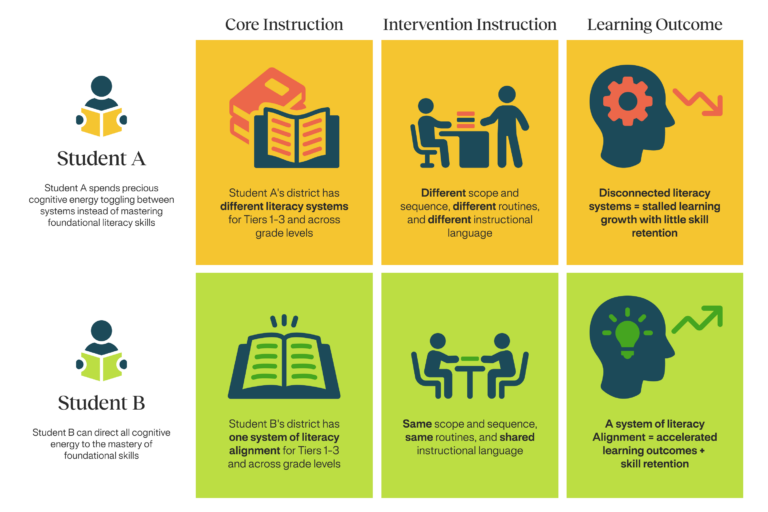
When literacy instruction is disconnected across tiers, grades, and classrooms, students spend valuable cognitive energy navigating different materials, routines, and language instead of building the skills they need. A system of literacy alignment changes that. Explore the 5 pillars that create a more coherent instructional experience and help move students from remediation toward learning acceleration.
In the foreword to our recent download, High stakes, high quality: Resources for literacy alignment, Chief Academic Officer at 95 Percent Group, Laura Stewart, opens with her experience walking into her very first classroom as a 6th grade teacher and discovering that she mostly had to figure out her curriculum on her own. No textbooks. No materials. No roadmap or scope and sequence that connected to the skills just learned in 5th grade and scaffolded for the skills to be learned in 7th grade.
No system of alignment.
According to Stewart, this experience has shaped the work she has devoted her career to—especially the work she has done around the importance of high-quality instructional materials, aligned to evidence and built to work together across tiers of instruction, grade-levels, and across the teachers that rely on them.
Most schools provide core reading instruction (Tier 1) to students with reading difficulties and then a supplemental reading intervention that often has little alignment or correspondence with their core reading program.
Thus, students with the most challenging reading problems are expected to integrate information from two often very different approaches to reading instruction.
Vaughn, S. & Fletcher
The false choice between “remediation” and “grade-level access”
In some ways, although most schools and districts now provide their teachers with materials of some kind, many still operate with disconnected instructional systems:
- One set of materials and routines for Tier 1 literacy instruction, and an entirely different set of materials and routines for Tier 2 or Tier 3 intervention instruction.
- A kindergarten teacher, a 2nd grade teacher, and a 5th grade teacher all teaching from a different sequence of skills in their classrooms—with students having to spend the cognitive energy to figure out the new materials, instructions, and routines each time they enter a new classroom or move between Tiers of Instruction.
- Schools within the same district using completely different curricula, operating in instructional silos.
Each of these scenarios leave the students who need the most support—and the dedicated, but busy teachers—with decreased cognitive bandwidth for teaching, learning, and integrating new skills.
Here’s the thing: the science of reading and the science of learning support the understanding that this is not how children learn best. The time is NOW to give ALL our children the best possible chance of becoming a proficient and even joyful reader and learner. And when we design our foundational skills instruction around the 5 Pillars of Alignment, what was once skill remediation and a never-ending intervention loop becomes learning acceleration, efficient intervention cycles, and grade-level success.
What is alignment, really?
It would be easy to chalk alignment up to a compliance item: something to have approved, or an important claim to be made about a resource.
But alignment is so much more than that.
A system of literacy alignment empowers every student to become a reader—by creating intentional resources and systems where assessment, instruction, and professional learning work together to create a coherent student experience, increasing the bandwidth for learning and retaining new skills, and unlocking the mastery necessary not only for grade-level success, but for lifelong opportunity.
The 5 Pillars of literacy alignment
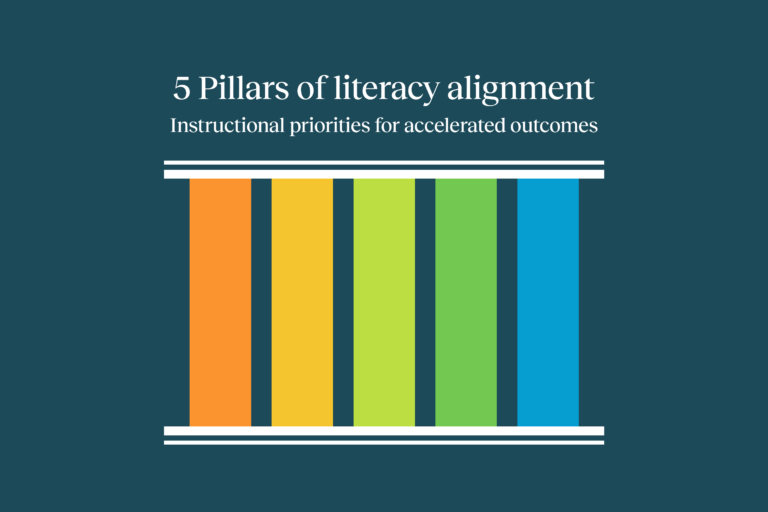
A system of literacy alignment is designed with these 5 Pillars—built to work together: Lesson design, Focused instruction, Resources and routines, Language, and Data. For students to have a truly coherent learning experience—one where they have the cognitive bandwidth for learning and mastering skills to automaticity—each of these 5 Pillars must be in place.
- Lesson design: Every lesson follows a gradual-release model—I do, We do, You do”—moving students from modeled instruction, through guided practice with meaningful feedback, to independent practice. Skill instruction always connects back to real reading and writing.
- Focused instruction: The same scope and sequence carries across every tier, and from K-5—with time and intensity increasing if students move from Tier 1 to Tier 3. Students always know why they’re learning what they’re learning.
- Resources and Routines: Consistent, high-impact resources and routines free up cognitive energy—for students to focus on learning instead of process, and for teachers to focus on instruction instead of logistics.
- Language: Clear instructional dialogue and consistent academic language turn research into something teachers can actually deliver with confidence, lesson after lesson.
- Data: Data connects every tier, pinpoints exactly what each student needs, and gives every invested party—teachers, leaders, families—visibility into progress.
Each is important on its own, but a coherent teaching and learning experience requires the intentional foundation of all five pillars working together.
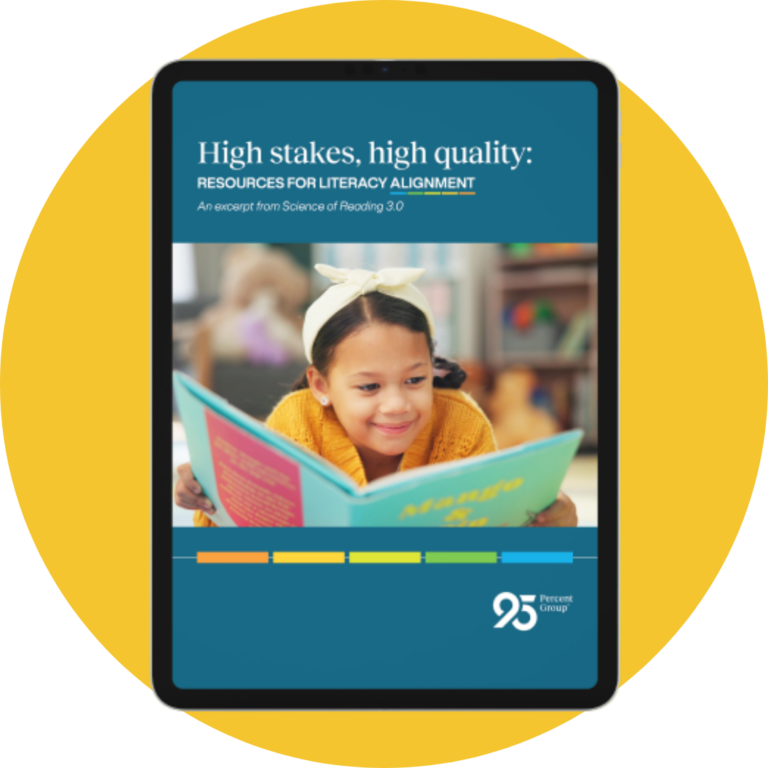
Want to take a deeper look at literacy alignment?
Explore the 5 Pillars of Alignment and discover how high-quality resources and connected instructional systems can support more coherent teaching and learning.
A system of literacy alignment accelerates learning
For decades, the default response to a student who had trouble with the foundational skills of reading was remediation: slow the pace down, simplify the content, and pull the student into separate instruction that often looked very different from their core instruction. The assumption was that a student whose skills were below grade level needed something different.
The evidence points elsewhere. If students are engaged in a high-quality tier 1 program within an aligned system of literacy instruction, those who have skill gaps shouldn’t need a completely different system—they likely just need more instruction. More instruction, built on the foundation of the 5 Pillars inside a connected system of literacy alignment, and delivered with increasing intensity, time, and dosage—creating a coherent, streamlined learning experience. This is the shift from remediation to acceleration: the same skills, the same academic language, and the same instructional routines students encounter in Tier 1, carried through Tier 2 and Tier 3 intervention with increased frequency rather than replaced by a separate approach.
The reduction of extraneous cognitive load that comes with an intentionally designed system of literacy alignment is significant. When students move between tiers or grades and encounter an unfamiliar instructional language, they spend unnecessary cognitive effort decoding a new approach and relearning the system itself before they can engage with the content—effort diverted from the skill-building they need. Instruction that is built on the foundation of the five pillars of alignment lets students instead direct their full attention toward skill mastery—necessary for automaticity and reading comprehension.
In fact, when the Fort Dodge School District in Iowa implemented 95 Tiered Solutions across grade levels, they saw a big difference for both teachers and students. Teri Boezinger, EDS, director of curriculum and instruction commented on this.
“It’s less taxing on my teachers actually. They enjoy teaching intervention, because they can jump right from core to Tier 2 and not have to learn a new system and not have to do separate data assessment pieces—it’s an easy transition for a classroom teacher to make to jump from core instruction to tiered lessons.
“They like not having to search for materials. What they need is in their hands. That’s very, very important, I think. I think that’s probably the biggest piece—they have what they need. We’ve purchased everything.
They have books, and they have materials—they’re not looking for anything. Everything is at their fingertips. Not only that, but one of the biggest payoffs we are seeing is with our students who have divergent behavior. As they make gains in literacy—their behavior is improving—significantly!”

Learn more about Fort Dodge’s Tier 2 implementation journey
When Fort Dodge Community School District in Iowa aligned Tier 2 intervention with a strong science of reading foundation, the impact was immediate. This spotlight shares early insights from their K–5 implementation journey and what’s changing for teachers and students.
What this means for schools
Laura Stewart’s’s foreword in High Stakes, High Quality: Resources for literacy alignment, closes with a truth worth returning to: Belief must be paired with practice. Aligned instruction is that practice—the tangible form our conviction takes when a student needs more than good intentions.
When schools design their literacy instruction around these five pillars, something shifts. Teachers stop reinventing instruction tier by tier and instead operate with clarity—trusting that what they’re doing connects to a cohesive whole. Students stop relearning the system every time they move classrooms or receive support, and instead experience coherence—one language, one set of routines—carried across every tier, grade, and across schools, district wide. Accelerated learning stops being the exception reserved for a few classrooms and becomes the goal and expected outcome of the system itself.
This is the vision a system of literacy alignment makes possible: when no student’s zip code, tier placement, or grade level determines whether they receive instruction designed with an expectation that all students can learn to read.

Share the 5 Pillars of Alignment
Download this exclusive one-sheet to share how high-quality, aligned instructional solutions bring the science of reading from theory into daily classroom practice, driving stronger student outcomes.