Balanced literacy vs. Science of reading and structured literacy

Two of the most widely used approaches to reading instruction, balanced literacy and structured literacy, reflect very different understandings of how children learn to read.
Balanced literacy combines elements of the whole language approach with some phonics instruction. While it was once the dominant model in many classrooms, research has shown that it often falls short in helping all students, especially those who struggle to build essential reading skills. In contrast, structured literacy is grounded in the science of reading—a vast body of research from cognitive science, linguistics, and neuroscience that shows reading must be taught explicitly and systematically.
In this post, we’ll explore how these approaches differ in practice, why those differences matter, and how science of reading-aligned instruction is equipping more students to become confident, capable readers.
What is the science of reading?
The science of reading is a dynamic body of convergent evidence that informs effective instruction in all areas of literacy development. The research on reading draws from multiple fields including cognitive psychology, cognitive neuroscience, linguistics, and developmental psychology. According to the research, reading isn’t natural or inherent. It must be taught through explicit instruction.
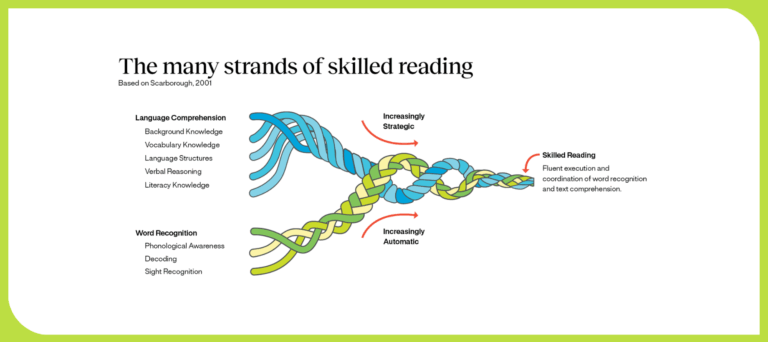
In the science of reading, foundational elements of reading include phonemic awareness, phonics, fluency, vocabulary, and comprehension. Each of these pillars are interconnected and essential for children to achieve literacy.
The Scarborough’s Reading Rope illustration demonstrates the interconnectedness of components of literacy.
When following science of reading-aligned instruction, studies show that over 95 percent of students can learn to read.
This is the most studied aspect of human learning.
Louisa Moats
What is balanced literacy?
The term and approach called “balanced literacy” emerged in the 1990s as a response to serious critiques of the whole language approach that was widely adopted in the 1980s and 1990s by school districts across the country. Whole language is a philosophy about teaching reading and writing, with origins that go back several decades. It is still widely in use throughout the U.S. despite strong evidence that its approach fails many students.
Balanced literacy added minimal guidance in phonics to the whole language approach—attempting to ”balance” whole language with phonics-based instruction. It focuses on components such as reading aloud, whole class shared reading, small group guided reading, and independent reading. Balanced literacy proponents share a belief that reading is a natural process that requires minimal explicit instruction.
How is balanced literacy different from the science of reading?
The main differentiator between the science of reading and balanced literacy is the role of phonics. According to the science of reading, phonics is a crucial foundational element. Students must master this skill, in addition to others, to become a strong, well-rounded reader.
On the other hand, balanced literacy proponents see phonics as a small piece of the puzzle that is not crucial to literacy. They see phonics as a mere tool and lean heavily on helping students use context clues to learn.
One controversial method in balanced literacy was “three-cueing”: when students come to a word they don’t know, teachers may encourage students to draw upon context clues, sentence structure, or even picture clues to figure out the word. Research has shown that three-cueing reinforces guessing at words and other habits used by unskilled readers. There have been many critiques of the three-cueing methodology, including senior correspondent Emily Hanford’s Hard Words—Why aren’t kids being taught to read, and since then, three-cueing has been eliminated or at least discouraged in most schools.
What is structured literacy?
You might have heard the term structured literacy used to describe an approach to reading instruction. The term originated with the International Dyslexia Association® (IDA®) in 2016 to differentiate reading instruction and programs that are truly informed by the science of reading from those that are not. It is based on decades of research showing that students need to know how the alphabetic code works and have sufficient language comprehension in order to understand what they read.The structured literacy approach focuses on explicit teaching of phonological awareness, phonics, and fluency, as well as the development of other key areas of literacy such as language, vocabulary, comprehension strategies, and writing. Teachers use direct instruction rather than relying on discovery or exploration to ensure students have no gaps in their knowledge of how reading works.
“[Science of reading-informed instruction and programs] are vital for students who are dyslexic, but it’s not just those students,“ explains Dr. Susan Hall, Retired Co-Founder, 95 Percent Group in a webinar on understanding the science of reading and structured literacy.
A structured literacy approach is grounded in evidence-based instruction—teachers and literacy specialists use a scope and sequence which informs the order in which concepts and content are taught using explicit and systematic, cumulative instruction.
Structured literacy also focuses on ongoing assessment to help teachers individualize instruction to guide kids towards skilled reading.In addition to the typical broad stroke universal screeners, structured literacy uses ongoing, finer-grained diagnostic assessments to identify skills gaps for intervention and monitor student progress in order to provide additional practice and scaffolding to close gaps quickly when they are identified.
How is structured literacy related to the science of reading?
Structured literacy is the application of the science of reading. It uses evidenced-based principles and findings of the science of reading to help students develop the necessary foundational reading skills of phonemic awareness, phonics, vocabulary, fluency, and comprehension. The principles of structured literacy apply to the development of language and literacy capabilities beyond the foundational skills as well.
It’s important to note that the science of reading and structured literacy do not refer to particular programs for students or for teacher professional development, but rather an approach to literacy instruction. Many well known programs such as the Orton-Gillingham Approach, Lindamood-Bell instruction, and others implement structured literacy in their approaches.
A structured literacy approach is also present in some programs for teacher professional learning—for example, 95 Percent Group’s teacher professional development.
Which method is preferred: structured literacy vs balanced literacy?
For the majority of learners, structured literacy methodology is preferred over balanced literacy when teaching students to read. While this form of instruction is completed using a variety of teaching methods (including phonics), balanced literacy lacks the structured support that structured literacy can provide. Its flexible nature enables instructors to teach components of reading disproportionately, resulting in inconsistent literacy development among students.
Meanwhile, structured literacy relies on explicit and systematic instruction that is grounded in evidence-based research. This method has a clear framework for teaching students language and literacy skills. Further, the structured and targeted instruction is beneficial to all students—including those struggling to read and those with learning impairments.
The national impact of ineffective reading instruction
Multidisciplinary research has confirmed that 95 percent or more of students can learn to read when provided with high quality, evidence-aligned instruction. Yet many students today are not learning to read. The 2022 “Nation’s Report Card” found thirty-three percent of fourth-grade students performed at or above the NAEP Proficient level and sixty-three percent of fourth-grade students performed at or above the NAEP Basic level on the reading assessment. The 2025 NAEP report had some better news for fourth-grade students—average reading scores increased by four points compared to the 2022 assessment. However, average reading scores for 13-year-olds remained stagnant compared to the 2023 assessment. This confirms that too many students arrive in middle school lacking the ability to access complex texts and content across subjects.
Every child and adolescent has the right to read and to read well. John B. King, former US Secretary of Education, and Jacquelyn Davis, fellow at Bellwether, write in The74: “The earliest years of a child’s education are critical for gaining functional literacy. From pre-K through third grade, students learn to read, and from grade three forward, they read to learn. Whether it’s science experiments, math word problems or drama scripts, students cannot learn if they cannot read, and 75% percent of children who are behind in third grade will never catch up…The resulting deficit trails students for the remainder of their academic life and beyond: For example, struggling readers are four times more likely to drop out of high school.”
What needs to change in literacy instruction?
For too many years now, a disconnect has existed in U.S. schools between what decades of reading research and neuroscience tell us and how teachers are trained. Many teachers leave their schools of education woefully unprepared to teach reading based on the research, and school districts throughout the country continue to use approaches to reading instruction that have been proven counterproductive to what we know about how the brain learns to read. Because many universities have not made the shift yet to providing courses designed to teach skills based in the science of reading, too many teachers have not been supported in mastering the key components of how to effectively teach their students to read.
Numerous experts in the science of reading are calling for significant changes in schools of education and professional development for teachers, principals, and school and district administrators, and ongoing coaching support for teachers in the science of reading. There is consensus among the literacy experts that a culture change is required. School districts and schools across the country are taking heed of what these experts and the science of reading research identifies about how best to teach reading. They’re committing to making the necessary changes to radically improve literacy instruction.
According to the writer Sarah Schwartz in an EdWeek post, Which states have passed science of reading laws? What’s in them? (updated April 24, 2026): “As of March 30, 2026, 42 states and the District of Columbia have passed laws or implemented new policies related to evidence-based reading instruction since 2013.” Many of these states, including Colorado, Mississippi, Tennessee, and Connecticut, have created comprehensive early literacy plans which require or incentivize districts to train teachers and adopt textbooks based in science of reading research. According to Edweek’s state by state table of literacy legislation and policy, a 2025 California law “requires the state to adopt instructional materials aligned to evidence-based reading methods and encourages districts to use them and train educators on them; a budget bill the same year allocates $200 million for professional development.”
A look at the research reveals that the methods commonly used to teach children to read are inconsistent with basic facts about human cognition and development and therefore make learning to read more difficult than it should be… in short, what happens in classrooms isn’t adequate for many children.
Mark Seidenberg
Implementing science of learning: Impact stories and best practices
To support a culture change that implements structured reading instruction, we put together a few exemplars who share their knowledge and experiences—from a small school of 590 students to a 4-school rural district to a major urban county with 59 schools.
School districts and schools implementing science of reading
Fairfax School District, Kern County, California
4 schools, 2688 students
David Mack, EdD, Chief Administrator of Business Services has worn many hats in the Fairfax School District—from math teacher to school principal. He did his dissertation on the topic Improving Fidelity of Implementation of a Tier I Phonics Program: An Improvement Science Study. David Mack shares his research, his experience in the district, and what he’s learned about best practices in implementation of the science of reading.
Val Verde Unified School District, Moreno Valley, California
21 schools, 20,000 students
Schools in Val Verde were facing several challenges in improving student reading outcomes and have been on a journey to strategically implement science of reading practice in their classrooms for a number of years. Val Verde’s journey highlights the importance of evidence-based, data-driven instruction, ongoing support, and a commitment to equitable education for all students. Aimee Garcia, Val Verde K-12 District Director of Education Services, has this to say about a consequence of not applying the science of reading: “The scope and sequence of a program is essential—if everyone is choosing to do their own thing, we are unintentionally creating an equity problem because we can’t guarantee that all students will receive instruction on the skills they need at the time they need it.”
Read the post, Spotlight California: Driving Momentum for Systemic Change.
Fulton County Schools, Atlanta, Georgia
59 schools, 90,000 students
For years, decisions about reading curriculum were left to the discretion of individual schools in Fulton County. Jennifer Burton, Fulton County’s director of literacy, weighed in on this idea: “This resulted in a hodgepodge of balanced literacy-based programs, not backed by the science of reading, that clearly weren’t reaching all students,” she said. When you have many school leaders all making different decisions, it becomes difficult to have clear communication and one guiding direction. The district needed one program based in the science of reading: a literacy program to implement across ALL of their elementary schools in order to all move in the same direction towards reading proficiency.
Additional Resources from 95 Percent Group
Structured Literacy
Insights from thought leaders and resources to help you bridge knowledge and practice as you bring structured literacy to your school or district.
Science of Reading 2.0: Implementation made easy
The next generation of the science of reading connects research about reading and learning to help educators implement effective literacy instruction.
Download this easy-to-use guide here.
Efficacy Studies
Efficacy studies designed with guidance from the Every Student Succeeds Act (ESSA), to meet the highest levels of evidence
We can all make a difference
Every child has the right to read and to read well. At the same time, teachers have the right to teach their students to read based on the most up-to-date knowledge about how the brain processes text. And parents and caregivers have the right to know and understand the research that shows that 95 percent or more of young people can learn to read when provided with high quality, evidence-aligned instruction. We can all make a difference in ensuring that our children and our students have the support and skills they need for success.
Learn more about One95 Literacy Ecosystem™
95 Tier 1 Phonics Solution provides explicit, systematic, and cumulative Tier 1 phonics instruction and strategic practice for both whole group and small group instruction. It is strategically designed to reduce or prevent intervention needs before they arise. This solution includes two components: 95 Phonics Core Program® building critical phonics skills to develop strong K-5 readers through explicit instruction in just 30 minutes a day, and Sortegories™ by 95 Percent Group: a web-based, teacher-directed practice tool that helps developing readers improve accuracy and fluency.
95 Tier 2 Phonics Solution includes assessments, grouping, instruction, and practice in one place providing everything you need to deliver effective, evidence-based intervention and help students in grades 1 through 8 quickly move out of intervention and develop as strong readers. This strategic intervention solution includes these two components: 95 Literacy Intervention System™: a school and district-level resource that combines assessment data, grouping tools and resource recommendations into one powerful tool—providing educators with the tools and data they need to make informed decisions that move students toward skill mastery more quickly and 95 Phonics Lesson Library™ 2.0: our trusted, evidence-based program that enables teachers to provide targeted intervention and deliver explicit instruction for each student’s unique needs. With fully prepared, ready-to-use lessons including routine-based instruction and built-in practice opportunities, the updated version now includes both print and digital options.
95 Tier 3 Literacy Solution is designed to identify and target foundational skill gaps to overcome barriers for students who need extra support, including those with dyslexia. This solution includes 95 RAP™ (Reading Achievement Program) integrates assessment, instruction, and data management to empower teachers to deliver individualized, teacher-led, tech-supported small group instruction—tracking student progress across all foundational literacy components so teachers can provide targeted, mastery-based support exactly when and where students need it.
Adolescent Word Study Solution is a flexible solution that is considered both a Tier 1 and Tier 2 resource. Designed for secondary classrooms, and including 95 Multisyllable Routine Cards™ Package and Morpheme Magic™ 3rd Edition, Adolescent Word Study Solution empowers students in grades 6-12 to decode and decipher multisyllable words—opening the door to academic language and cross-curricular success.
Are you interested in learning about how you can bring an effective and efficient structured literacy approach, grounded in the science of reading, to your school or district? Contact 95 Percent Group today.