Spotlight Idaho: A gradual approach creates sustainable, district-wide literacy change
Madison School District's gradual implementation of structured literacy tools has created remarkable results—kindergarten scores doubling in less than a year and students retaining skills even after months away from their English language literacy instruction. Their phased approach built teacher buy-in while diagnostic assessments ensured no student fell through the cracks, proving that systematic implementation creates sustainable literacy change.

Madison School District 321 Snapshot:
- 5,668 students
- 35% Title I
- 12% Special Education
- 6-7% Hispanic
Product highlight:
- Resources for all tiers from One 95 Literacy Ecosystem™ *
*Including but not limited to: 95 Phonics Core Program™, 95 Phonics Lesson Library™, 95 Literacy Intervention System™, 95 RAP™
Students at Madison School District 321 in Idaho are showing mastery and retention of foundational literacy skills at a very high rate—even from the end of one school year to the beginning of the next. In fact, when an elementary student who participates in intensive literacy intervention returned after three months away from school in a non-English speaking environment, her 95 Phonics Screener for Intervention™ (95 PSI™) assessment revealed something extraordinary—she had retained every literacy skill she’d mastered before leaving. Her story—and so many others—beautifully illustrates what happens when districts implement an effective, systematic, and research-based structured literacy approach.
We need this—now
10 years ago, Madison School District’s Director of Curriculum, Darnea Lamb, knew something wasn’t quite working for her elementary students when it came to literacy acquisition. They were using an ELA curriculum that didn’t have dedicated phonics instruction, and as students entered the upper elementary grades, they were having a hard time decoding multisyllabic words.
Presenting at a Title I conference Lamb attended, was Dr. Susan Hall—a now-retired cofounder of 95 Percent Group. She was there to present on the 95 Multisyllable Routine Cards™ (95 MSRC), a product targeting the type of advanced decoding skill Lamb knew her students were missing.
Lamb turned to her colleague and said, “We need this…right now.”
And that was just the beginning.
Confidence and buy-in through phased implementation
Lamb had teachers using 95 MSRC immediately—at just one elementary school at first. But they didn’t stop there. The next year they purchased both forms of diagnostic assessment plus the 95 Phonics Lesson Library™. By testing every single student with these tools, the district could truly get a full picture of what it would mean to meet students where they are.
Eventually, they invested in resources across the One95 Literacy Ecosystem—bringing in structured literacy resources to meet the needs of all of their students—across Tiers 1, 2, and 3 and from kindergarten all the way through 12th grade.
Yes, educators at MSD 321 have even had intervention success with high school students. “One of our instructional coaches has used 95 Phonics Lesson Library with some of our special education students,” Lamb said excitedly. “The students were 17 and moved through all of the skills in about three months— they were truly starting to read. Which is amazing since none of them were reading previously.”
“Before starting with 95 Phonics Lesson Library, the students were using a different program,” Lamb continued. “But it was moving too slowly. With the Phonics Screener for Intervention, we could test each student to see where the holes were and begin targeted instruction exactly from that point.”
Data led the way
And it’s not just inside the district that people have noticed the progress students are making with explicit, systematic, direct instruction. “One of the districts near us has decided to follow our lead with 95 Percent Group resources,” Lamb said. “Except they have opted to begin everything at once. We have offered support in terms of the way we set things up, but I’m exhausted just thinking about having to figure it all out at the same time.”
This is one point that Lamb and her district instructional coach, Julianne Dennis, both emphasize. They really believe that part of their success, and a huge reason that so many teachers feel so empowered, is the gradual addition of new resources. “We just kept following the data,” Dennis said. “We used the data we were getting to figure out what we needed next.”
The gradual roll out offered teachers time to get used to one thing before they immediately brought in something new.
Professional learning innovation and support for teachers
It’s clear that this team understands the idea that teachers teach kids, not programs. And one of the big advantages to bringing each component in one at a time was that it also offered the admin team time to make sure they were handing teachers a fully prepared teaching kit.
“We never give teachers a product that’s not completely ready to go,” Lamb and Dennis added, talking about their community of paraprofessionals and parents that help to ensure that all materials are prepared before teachers get them.
“We keep everything in one room,” Lamb added. “In color-coded binders and zip-lock bags when there are lots of pieces. Teachers can just sign them out and go.”
Here’s what their gradual rollout looked like:
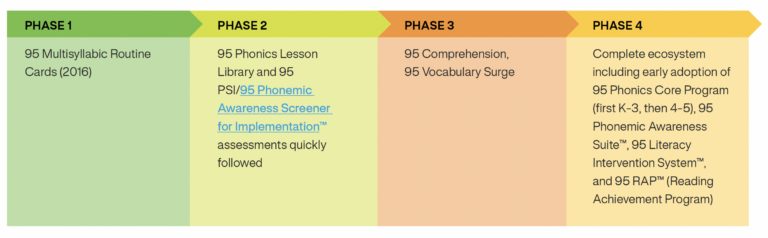
If we had taken everything at once, we wouldn’t have had the same buy-in. Teachers believed in getting the next new resource because they’ve been able to see the ones before them work.
Darnea Lamb
Before they arrive in the room to get the materials? Their teachers have the opportunity to earn college credits by working through Madison School District’s professional development opportunities with Idaho State University. Lamb has created a Professional Development college credit called “95 Percent Implementation Practices.” Teachers attend 95 Percent Group Inservice training and then teach with any of the products for 15 hours, write up a brief summary of what they have learned, and can qualify for a college credit.
Additionally, the district works closely with Brigham Young University-Idaho to help train pre-service teachers in the science of reading through hands-on experience and student teaching opportunities with students who are using 95 Percent Group products. University students come to their schools for a Literacy Practicum course where they support students in Walk-to-Read programs and teach small groups using the phonics intervention products, as well as Tier 1 groups in 95 Phonics Core Program. “We take the time to train BYU-I students in our buildings, and then we’re able to have smaller intervention group sizes,” Lamb explained. “The pre-service teachers walk away with hands-on experience, and a real understanding of why these products are amazing.”
High expectations: Meeting the needs of ALL students
Because they use 95 PSI™ and 95 PASI™ with every student in the district, they know that each student—regardless of their baseline—is getting what they need. “One of the best things about these resources,” Dennis said, “is that we know we are meeting every student where they are. For example, we have dyslexia legislation in Idaho, which requires that we have the ability to properly screen and meet the needs of our students with dyslexia. Knowing we don’t have to worry about recreating the wheel—because we know that 95 Percent Group products support what ALL students need to learn how to read—is beyond helpful.”
In fact, one of the expectations created in the district is that 95-98% of students will test out of each skill. “We outlined expectations by grade level in terms of which skills need to be mastered by the end of the school year,” said Dennis. “And the students really have been moving through them—including most IEP students being able to move on to multisyllabic word reading by mid-third grade.”
One important part of this model? “With our Walk-to-Read program, every student gets the exact targeted instruction they need. Those that are still working towards grade level expectations, and those that have already mastered them.”
Plus, with the purchase of 95 Phonemic Awareness Suite last year, educators at Madison have noticed that their Kindergarteners are showing a much stronger foundation in phonemic awareness skills. In addition, the extra instruction in phonemic awareness has been especially supportive for EL students.
Data-driven transformation
At Madison, assessment isn’t just an event—it’s the engine behind every instructional decision. The 95 PSI and 95 PASI aren’t treated as compliance tools or one-and-done screeners. They’re diagnostic instruments that educators at Madison SD use to shape daily instructional practice. One important addition? 95 Literacy Intervention System—95 Percent Group’s digital diagnostic tool that quickly identifies skill gaps, groups students for precisely mapped intervention, and provides ongoing progress monitoring to maximize reading outcomes. And it’s changed the way educators in the district can collaborate around data.
“With 95 LIS, nothing can fall through the cracks,” Dennis explained. “It’s not just the numbers that are helpful, but where students have been and what interventions they’ve already had. Before, it felt like teachers were looking at their data in a silo. Now everyone has the same view of all the data. This clarity has shifted conversations from the surface level question of who qualifies? to the deeper and more specific question of what does this student need next?”
With these tools, teachers know exactly which skill to target when they provide an extra dose of instruction. No more guessing. No more students stuck in skills they’ve already mastered—or lingering in gaps that no one has identified. “With the knowledge that our students are retaining skills so well,” Dennis explained, “and a huge benefit to having our data in 95 LIS is that we don’t have to waste time assessing students at the start of the school year.”
“Instead,” she continued,” we are able to get started with interventions on the skill they left off on in the previous grade. We are able to keep students moving instead of getting stuck in lower skills. This is beneficial because we are able to move them on to multisyllabic words sooner!”
Real teacher growth
That level of precision has transformed teachers, too. Some of the teachers who were initially hesitant are now among the program’s strongest advocates. In the last 18 months, Lamb has seen what she calls “tremendous growth”—from educators who once struggled to carve out time for assessments to professionals who now see data as wholly empowering.
In a transient college town where new teachers join the district regularly, that matters. “If a first-year teacher uses the program with integrity, I know students won’t suffer due to inexperience,” Lamb said. And it’s not just the students that need extra support—“on-grade-level” students are benefitting too.
“When 95 Phonics Core Program helped to clean up lingering gaps,” Dennis said, “classrooms experienced unexpected moments of leadership. Students who once struggled with foundational skills were suddenly confidently modeling manipulatives for peers.”
The result isn’t just stronger readers. It’s stronger instructional confidence across the district.
Results and a district-wide vision for literacy
The impact is measurable—and it’s accelerating. At the start of one school year, just 32% of kindergarten students met benchmark expectations. By mid-year, that number had jumped to 64%. A 100% increase in just a few months. The district has since placed in the top 10 statewide on literacy assessments. This is a big point of pride—but not the finish line. Last summer, Randy Lords, Madison’s District Superintendent, made a bold declaration: no child will graduate from Madison without learning to read.
Literacy is no longer an elementary initiative. It is a K–12 priority.
“95 Percent Group provides a fantastic product,” Lords points out. “But it’s just a tool unless you have the right people in place. Our team has maximized its potential completely. It’s the perfect storm—amazing educators with an exceptional product. Neither is as powerful alone, but together they’re transformational.”
And Lamb’s goal is clear—and characteristically ambitious. “I want 95% of our students to be on grade level.” With continued refinement of instruction, and growing teacher fluency in using data intentionally, that goal feels increasingly attainable. What began as one administrator’s instinct at a conference has evolved into a cohesive, district-wide literacy ecosystem—built gradually, guided by data, and sustained by teacher belief.
In Madison School District, structured literacy isn’t a program. It’s a promise.

Bring this success story to your team
Download this literacy transformation story and share with district leaders, literacy teams, school administrators, and instructional coaches.