Choosing a Tier 1 reading program: What school and district leaders should know
Discover what school and district leaders should look for in a Tier 1 literacy program, from science of reading alignment to implementation and long-term success.
A post from our Literacy learning: Science of reading blog series written by teachers, for teachers, this series provides educators with the knowledge and best practices needed to sharpen their skills and bring effective science of reading-informed strategies to the classroom.
Many schools continue to face persistent reading challenges despite investing heavily in intervention programs and supplemental resources. The reality is that intervention cannot compensate for weaknesses in Tier 1 instruction—strong literacy outcomes begin with strong core instruction.
When there is alignment in core reading instruction and intervention, students experience a cohesive learning journey. However, in many schools, students receive core instruction based on one approach and intervention based on another. This lack of alignment places an additional burden on the students who need the most support.
For district and school leaders, selecting a Tier 1 reading program is an opportunity to strengthen literacy outcomes for all learners while creating consistency across classrooms and intervention settings. Here’s what to consider when evaluating your options.
Why an effective Tier 1 reading program matters for K-5
Tier 1 instruction serves as the foundation of a Multi-Tiered System of Supports (MTSS). It is the core instruction all students receive and should be designed to meet the needs of the vast majority of learners.
Research consistently demonstrates that foundational reading skills remain essential beyond the primary grades. There used to be a pervasive belief that students simply moved from “learning to read” to “reading to learn.” We now understand that they continue developing reading skills while simultaneously using reading to acquire knowledge throughout their academic careers. (Educational Testing Services Research Institute, 2024)
Students who have difficulty with word recognition are unlikely to improve reading comprehension, regardless of how much comprehension instruction they receive. Yet many schools stop routinely assessing foundational reading skills after third grade, making it difficult to identify and address ongoing skill gaps. (Educational Testing Services Research Institute, 2024)
An effective Tier 1 program helps schools:
- Build strong foundational reading skills for all students K-5
- Prevent reading difficulties before they require intensive intervention
- Ensure instructional coherence across classrooms and grade levels
- Support data-based decision-making
- Create alignment between core instruction and intervention
Signs your school or district might need a new program
Not every literacy challenge requires a new curriculum. However, several indicators may suggest it’s time to reevaluate your current Tier 1 program.
- Instructional materials are no longer aligned with state literacy requirements.
- Student achievement data reveals persistent reading gaps.
- Growth metrics have stagnated over multiple years.
- Teachers and instructional coaches report challenges implementing lessons effectively.
- The curriculum lacks alignment with current science of reading research.
- Too many students require intervention services.
The strongest sign that Tier 1 instruction is not meeting students’ needs is when large numbers of students require supplemental intervention. In many cases, the root cause lies in the effectiveness of core instruction. Research shows that with high-quality, Tier 1 structured literacy instruction, 95% or more of children can learn to read (Moats, 2020). Therefore, when many students need additional support, it may indicate a need to strengthen core classroom instruction rather than rely primarily on intervention services.
What makes Tier 1 instruction different from intervention?
Tier 1 instruction and intervention both support literacy growth, but they differ in purpose and intensity. Tier 1 provides high-quality core instruction for all students, while intervention offers additional, targeted support for students who need it. Both rely on explicit, evidence-aligned practices and data to ensure students receive the instruction they need to succeed.
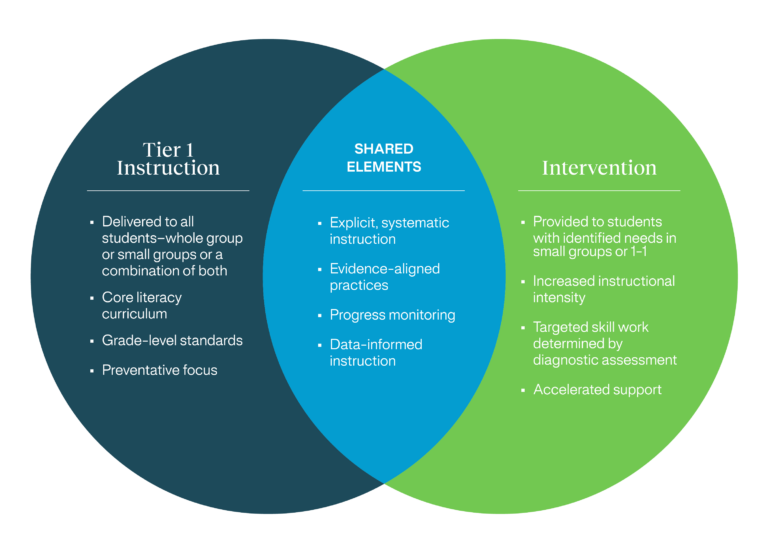
The most effective systems align instruction across tiers so students experience reinforcement rather than conflicting approaches. Intervention should add support, not replace or contradict core instruction.
What to look for in a Tier 1 reading program
Choosing a Tier 1 literacy program requires looking beyond marketing claims. Leaders should evaluate whether a program can deliver sustainable outcomes across grades, classrooms, and student populations.
Comprehensive K–5 coverage
Effective literacy programs support students across all elementary grades, building foundational skills in the early years while advancing fluency, morphology, multi-syllabic decoding and comprehension strategies as texts become more complex.
Alignment to the science of reading
Look for programs that are both evidence-aligned and evidence-based:
- Evidence-aligned: Consistent with the extensive body of research known as the science of reading, as well as the sciences of learning, teaching, and implementation.
- Evidence-based: Supported by studies demonstrating positive outcomes with real students in real schools.
Strong support for English learners
Instruction that provides substantial coverage in the key components of reading – identified by the National Reading Panel as phonemic awareness, phonics, fluency, vocabulary, and text comprehension – has clear benefits for English learners. However, research also suggests adjustments and scaffolds for maximum support for these students, such as oral language opportunities, visuals and graphic organizers, and time for additional practice. (August & Shanahan, 2006)
The right text at the right time
Beginning readers need decodable texts that align with phonics instruction, build skills cumulatively, and encourage reading through engaging, natural language. At the same time, even the earliest readers need to hear the rich language of more complex literature and nonfiction through read-aloud texts. Decodable controls gradually give way to uncontrolled texts as readers become more independent and capable.
Assessment systems aligned with instruction
Assessments should inform action, providing screening,diagnostic assessments, progress monitoring, and clear instructional guidance for all teachers who instruct a student, and data visibility for all invested parties.
Complete instructional resources and scalability
Effective instruction follows a gradual release mode (I do, We do, You do) l, in which teachers provide explicit guidance before gradually shifting responsibility to students through targeted, responsive practice (Rosenshine, 2012). Look for programs that support flexible grouping, targeted practice, and responsive instruction to make this shift possible.
Programs should include ready-to-use materials with clear, consistent instructional dialogue and academic language that reduces teacher preparation while supporting consistent implementation across classrooms and schools. Scalable solutions help districts implement with integrity as they expand adoption.
Professional learning and ongoing support
Even the strongest curriculum requires implementation support. Invest in available training, coaching, and professional learning opportunities.
Alignment across tiers
Instructional approaches, routines, and language should remain consistent across Tier 1 and intervention settings—helping to set students up for a coherent learning experience.
What to ask when comparing Tier 1 options
As you evaluate vendors, ask questions that go beyond product features.
- How does the program progress across grades K–5? A high-quality program should provide a coherent instructional pathway from kindergarten through fifth grade, building skills systematically over time.
- What foundational skills routines are included in kindergarten and grade 1? Early literacy instruction should include explicit routines for language development, phonemic awareness, phonics skills, reading fluency, vocabulary, and reading comprehension.
- What materials are provided? Programs vary widely in the resources they include, from teacher guides and student materials to assessments, decodable texts, and digital supports. Comprehensive materials reduce teacher preparation time, promote consistent implementation, and help ensure educators have the tools they need to deliver effective instruction.
- What initial training and ongoing professional learning are provided? Successful implementation often depends on more than curriculum alone. Ask about onboarding, coaching, and opportunities for continued professional learning. Even evidence-based programs require support over time to implement with fidelity.
- What is the required teacher preparation time each week? Every program will have its own requirements, but programs that require extensive preparation can create implementation challenges and increase teacher workload. Streamlined resources help educators focus more time on instruction and student learning.
Budget and implementation planning for Tier 1 solutions
A successful Tier 1 adoption requires thoughtful planning for implementation and long-term sustainability.
Consider all costs and explore funding sources
Budget planning should account for both upfront and ongoing costs. In addition to curriculum materials, districts should consider expenses related to professional learning, coaching and implementation support, technology requirements, consumable student materials, and annual renewals or subscriptions. Understanding the total cost of ownership helps districts plan for sustainability beyond the initial purchase.
Districts should also explore multiple funding sources to support implementation. Depending on local and state policies, funding may come from state literacy grants, federal programs such as Title I or ESSER carryover funds, local district budgets, or school improvement funds.
Pilot and develop an implementation plan
When possible, pilot the program before scaling district-wide. Implementing a solution in a small number of classrooms or schools allows leaders to gather teacher feedback, identify implementation challenges, and refine supports before a broader rollout. For example, a district might pilot a new literacy curriculum in one elementary school or with a group of K–2 teachers before expanding implementation across all grades.
Check out how this Texas School District piloted 95 Phonics Core Program in grades 4 and 5!
Your implementation plan should include a realistic timeline that accounts for the two to four years full implementation typically takes, along with the key elements that sustain complex change: a literacy-specific vision, professional learning to build educator skills, adequate resources and support, and a concrete action plan with defined next steps. It should also build in cycles of coaching, classroom observation, and data review to guide ongoing refinements, plus a clear path to a sustainability phase so the work continues even through leadership turnover.
95 Percent Group’s Tier 1 literacy solutions
95 Percent Group offers evidence-aligned literacy solutions designed to support foundational reading development across elementary grades while creating alignment across tiers.
95 Tier 1 Phonics Solution includes:
- 95 Phonics Core Program®–a comprehensive foundational literacy solution with explicit phonics instruction, decodable text, assessments, and teacher resources aligned to the Science of Reading.
- Sortegories™–a digital practice tool that helps students strengthen fluency and vocabulary through engaging activities aligned to the 95 Phonics Core Program® scope and sequence.
Our aligned Tier 1 products include:
- 95 Decodable Duo™ Books–support decoding practice in kindergarten and first grade with flip-book stories that begin as text-only, then reveal engaging illustrations to build comprehension and confidence.
- 95 Readables™–Chapter books for grades 2–5 that give students meaningful practice with newly taught phonics skills through engaging fiction and nonfiction texts.
- 95 Phonemic Awareness Suite™–A complete set of core, assessment, and intervention tools that help educators deliver skill-specific phonemic awareness instruction for kindergarten and first grade students.
- Professional Learning–Build educator knowledge and confidence with professional learning grounded in the Science of Reading. Sessions support effective instruction, classroom application, and stronger literacy outcomes.
- District Implementation Services–Support a successful rollout with expert guidance, planning, and coaching. Implementation services help schools and districts use 95 Percent Group solutions with clarity and consistency.
Tier 1 implementation FAQs
Schools can measure fidelity through classroom observations, implementation checklists, coaching cycles, lesson artifact reviews, and student outcome data.
Schools can measure fidelity through classroom observations, implementation checklists, coaching cycles, lesson artifact reviews, and student outcome data.
Many districts begin seeing early implementation indicators within the first year. Meaningful shifts in proficiency often emerge after one to three years of consistent implementation.
Many districts begin seeing early implementation indicators within the first year. Meaningful shifts in proficiency often emerge after one to three years of consistent implementation.
Provide ongoing professional learning, instructional coaching, collaborative planning opportunities, and clear implementation expectations.
Provide ongoing professional learning, instructional coaching, collaborative planning opportunities, and clear implementation expectations.
Tier 1 programs provide core instruction for all students, while intervention materials provide targeted support for students requiring additional assistance.
Tier 1 programs provide core instruction for all students, while intervention materials provide targeted support for students requiring additional assistance.
Use screening and diagnostic assessments to identify needs quickly, then provide targeted support while integrating students into core instruction.
Use screening and diagnostic assessments to identify needs quickly, then provide targeted support while integrating students into core instruction.

Expert Biography
Laura Stewart is a nationally recognized science of reading and structured literacy advocate, author, and expert who is building 95 Percent Group’s thought leadership position in the literacy market. Laura has dedicated her career to improving literacy achievement at leading education companies including The Reading League, Highlights Education Group, and Rowland Reading Foundation.
Sources
- ETS Research Institute, Replicating Decoding Threshold in ReadBasix®: Impact on Reading Skills Development, Research Memorandum RM-24-06 (Princeton, NJ: Educational Testing Service, 2024), https://www.ets.org/Media/Research/pdf/RM-24-06.pdf.
- Moats, Louisa. “Teaching Reading Is Rocket Science: What Expert Teachers of Reading Should Know and Be Able to Do.” AMERICAN EDUCATOR. Vol. SUMMER 2020, season-02 2020. https://files.eric.ed.gov/fulltext/EJ1260264.pdf.
- Rosenshine, Barak. “Principles of Instruction: Research-Based Strategies That All Teachers Should Know.” American Educator 36, no. 1 (Spring 2012): 12–19. https://www.aft.org/sites/default/files/periodicals/Rosenshine.pdf.
- Diane August and Timothy Shanahan, eds., Developing Literacy in Second-Language Learners: Report of the National Literacy Panel on Language-Minority Children and Youth, Executive Summary (Mahwah, NJ: Lawrence Erlbaum Associates, 2006), https://www.cal.org/wp-content/uploads/2024/04/cal_documents_executive-summary-developing-literacy-in-second-language-learners-report-of-the-national-literacy-panel-on-language-minority-children-and-youth_august-shanahan_2006.pdf