It’s time to widen the lens on literacy
Literacy is more than a skill—it’s access, opportunity, and freedom. Science of Reading 3.0 expands the conversation, connecting language, learning science, and systems thinking to help schools build lasting, equitable literacy outcomes for every student.

ALL of our students come to us with potential. Literacy helps unlock that potential. This is our collective calling. Every child deserves the freedom that comes with being able to read.
Ameer Baraka
In the years since the Report of the National Reading Panel, the body of research we call the science of reading has become a movement. This has resulted in both increased knowledge of best literacy practices, and a greater focus on helping children learn to read with proficiency and joy.
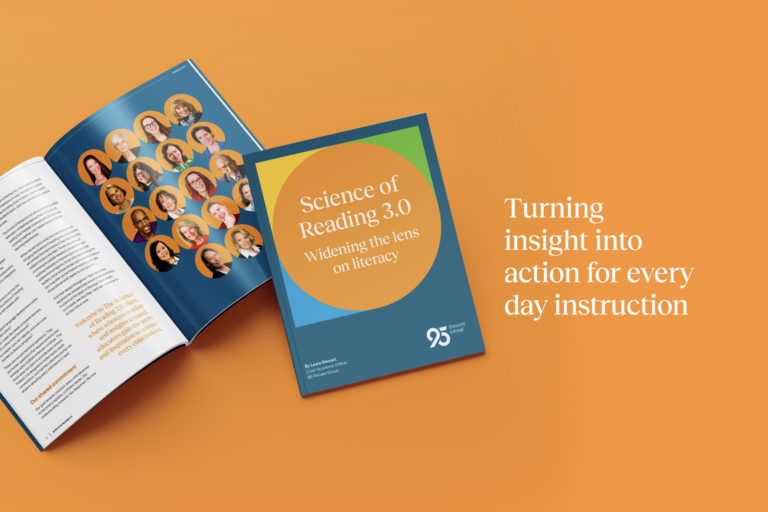
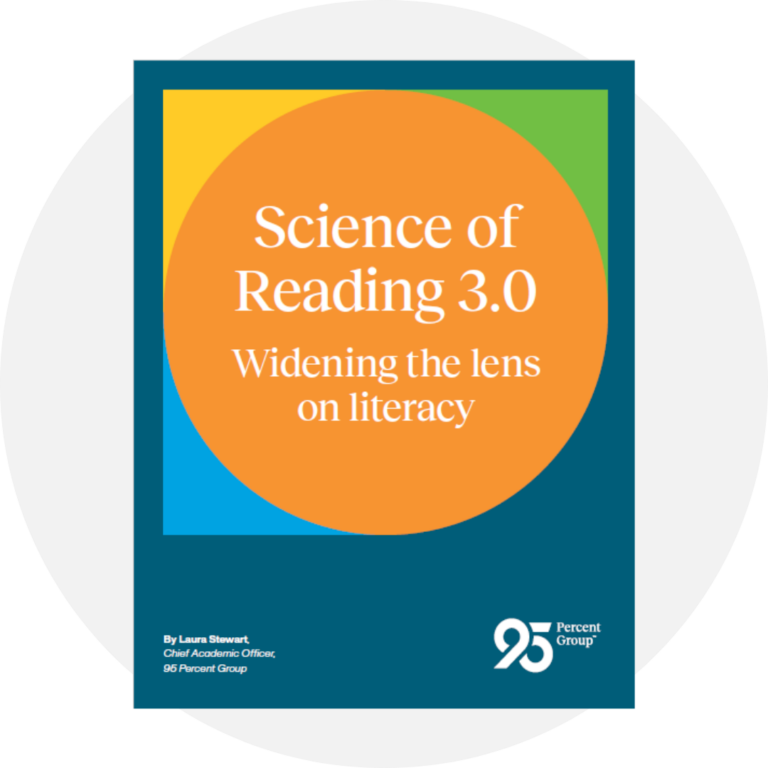
We know that the science of reading is a dynamic body of research, and as such there is more to explore! Building on our prior work (Science of Reading 2.0), our new book, Science of Reading 3.0: Widening the lens on literacy, integrates five converging disciplines—the science of reading (with a focus on language), the science of learning, the science (and art) of teaching, implementation science, and leadership—to offer a more holistic, integrated vision of literacy instruction within a systems-thinking framework to not only achieve positive outcomes for all of our students but sustain them as well.
3.0 Key areas of Focus
Language is everything

Early language development is not just a precursor to reading—it is its foundation. The continuous interplay between biology and environment means that even subtle differences in early experiences can shape a child’s trajectory in both language and reading.
Ann Kaiser, PhD
In 2025, researcher and Science of Reading 3.0 guest contributor, Margaret J. Snowling, together with research Charler Hulme, presented on their Reading Is Language (RIL) model. Our latest book highlights these ideas: that oral language—including phonology, vocabulary, morphology, syntax, semantics, and pragmatics—is not just something that happens leading up to literacy learning, but rather is its living foundation and sustenance. Every literacy skill that children acquire sits within language.
So, yes, language development begins at birth—but continues to shape every dimension of reading and writing throughout a learner’s life.
Science of learning:
These six principles should guide instructional design to align with how the brain actually learns: review, learning load, attention, practice, feedback, and environment. Specific examples of practice are provided that connect the science of learning with the science of teaching.
Equity: “All means all.”
The book addresses the unique needs of adolescent readers, English learners, African American English speakers, advanced readers, and students with dyslexia. Effective, evidence-based instruction must reach every learner.
Teacher preparation and professional learning:
A significant gap exists between what research tells us is needed, and what teacher preparation programs currently provide; guiding principles for institutions of higher education are explained. To learn the “rocket science” of reading, comprehensive, sustained, rigorous, and practical professional development is essential, as is the practice of being a reflective professional, carefully and consciously honing their craft.
High-quality instructional materials:
Effective resources must be evidence-aligned, span K–5, support cross-tier consistency, and include third-party efficacy studies.
Implementation science:
Sustainable literacy reform requires systems thinking, aligned leadership, collaborative teaming, and long-term commitment—not isolated initiatives or short-term fixes.
Zooming out
Widening the lens to study how each of these areas both inform and overlap with the next is the natural continuation of this important work—because the future of literacy isn’t about choosing sides (or sciences!). It’s about seeing how multiple sciences and disciplines are working together to create learning experiences grounded in each.
In writing this next iteration, we knew we needed the brilliant minds shaping this field—researchers, teacher educators, literacy leaders, and advocates whose stories and expertise bring these ideas to life. Find their essays woven throughout these pages, and you’ll quickly understand why they—and we—remain so deeply committed to this critical mission.
Access leads to joy
It’s no surprise that when children aren’t given the tools to read with fluency, it’s difficult for them to develop a love for reading. You can’t love something you can’t do well. We used to think some kids just “didn’t like” reading as much as others. Some believed that it was “too boring” to have students do the intentional, and yes, often repetitive practices that build a strong literacy foundation. But the truth is, joy in reading follows accessibility. One cannot exist without the other. Structured, explicit instruction is not the enemy of joyful reading—it is the gateway to it.
And every child deserves both the lifelong skill and joy that literacy unlocks.
So many of you are courageously leading the charge toward an equitable, sustainable literacy program that helps create access to the joy of reading for everyone. So many more are asking, “How do I begin this work in my own school or district?”
I’d like to offer three steps—taken from the Science of Reading 3.0—that you can use right now to move toward a literacy program that is evidence-based and aligned with the science of reading research:
- Start with language—intentionally. Audit your current literacy instruction to ensure oral language development is woven into every grade level and content area—not just the ELA block. Build in structured speaking routines, vocabulary instruction, and read-alouds that expose students to complex syntax and rich academic language every day.
- Move from program fidelity to instructional integrity. Don’t just follow a program—understand why it works (and what’s not working!). Invest in professional learning that builds your foundational knowledge of how students learn to read, so you can make informed, in-the-moment instructional decisions that put student needs at the center.
- Lead with systems thinking, not quick fixes. Whether you’re a teacher, coach, or administrator, resist the pull of isolated initiatives. Align your assessments, instruction, interventions, and professional learning around a shared literacy vision—and commit to it over time. Sustainable literacy transformation is built on coherence, not compliance.
Resources
- Snowling, Margaret J., and Charles Hulme. “The Reading Is Language Model: A Theoretical Framework for Language and Reading Development and Intervention.” Annual Review of Developmental Psychology 7, no. 1 (July 4, 2025): 195–218. https://doi.org/10.1146/annurev-devpsych-111323-084821.