Spotlight Washington: Closing gaps with structured literacy
In Washington, schools are closing literacy gaps by implementing structured literacy practices that give students the systematic support they need to read with accuracy and confidence. Focusing on intentional instruction and aligned systems is helping learners build stronger, more durable reading skills.

District snapshot
- Located in East Seattle on Lake Washington
- 4,057 students across 6 schools (4 elementary schools)
- 43% minority enrollment
- 3% eligible for free or reduced lunch
Educators at Mercer Island School District, in East Seattle, faced a persistent challenge: despite using existing curriculum resources, they were seeing significant gaps in student literacy skills, particularly among struggling readers.
“We’ve been aware of the Dyslexia legislation and involved in the community for at least the last 10-12 years, looking at what additional supports we can provide to meet student needs—especially for struggling students,” explains Amy Wick, learning support/special services teacher at Northwood Elementary. “But there were still unmet needs. We knew we needed something else, additional tools and education.”
Addressing unmet literacy needs
The disparity between readers was particularly concerning. As Abbey Espegarde, an instructional coach at West Mercer Elementary noted, “Just because we have resources, experiences, and literature-rich environments, doesn’t necessarily mean that students come already prepared. There was a very big gap between those who can read and those who can’t.”
The district decided to implement some of 95 Percent Group’s structured Tier 2 literacy resources, including 95 Phonics Lesson Library™ with 95 Phonics Chip Kits™. They secured grant money for Multisyllable Routine Cards and Morpheme Magic for intermediate grades as well.
A key strength of the implementation was its flexibility. “Buildings are using it really differently,” Wick noted. Some schools launched what we are calling “pilot classrooms” in grades 1-3 and 5, while others incorporated the resources into their intervention blocks. In the pilot classrooms, instead of pulling kids out of the environment, they are offering all tiers of needed instruction across the school day, in their classroom.
From September to January, almost 50% of the students in the pilot classrooms reached one year’s growth, or more, by the middle of the year assessment.
A perfect match for their LETRS training initiative emerged. “Our district has put a big emphasis on LETRS training. Because of this, teachers had the knowledge they needed, and now they had the practice and resources to apply it,” shared Wick.
The grammar and phonics committee
Among the most profound impacts though, was how the program transformed students’ relationship with reading. Espegarde shared a powerful example. “In one 4th grade classroom, students started with the Multisyllable Routine Cards on skill level 2, moving really slowly as timid readers. Now, they call themselves the ‘Grammar and Phonics Committee’ in the classroom. They started with a feeling of insecurity, and now they’re the experts. It’s totally transformed how they see themselves.”
“There’s now so much joy in something that kids have found particularly challenging before,” offered Nova Williams, executive director of learning services for the district. “And so the fact that they’re really owning it is just amazing. We’re getting communication from our pilot classroom parents in particular, around just how excited they are about their kids’ progress.”
I was in one of our 4th grade classrooms yesterday taking some photos and capturing some student voices, and kids were throwing around phrases like ‘where’s the syllabic boundary?’ All I could think was, ‘OK, I’m loving this!
Abbey Espegarde
Closing gaps and empowering teachers with precise tools
The impact on student achievement was measurable. One teacher saw her class move from 48% proficient to 62% proficient between beginning and middle-of-year assessments.
“It’s been incredibly evident at Northwood—using Tier 2 with special services students, the growth they have been making is absolutely astounding. We’ve had to amend IEPs more this year than ever before,” Wick reported.
Student spotlight
The structured, hands-on materials proved particularly effective for students with diverse learning needs.
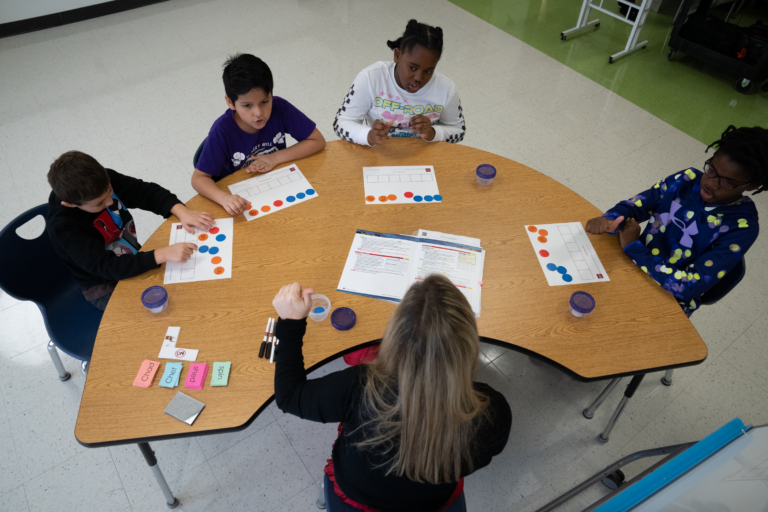
“We had an ‘aha moment’ in 1st grade with a student who really needed visuals for learning,” Wick recalled. “When we introduced the colored chips, it really clicked for her. So of course she started off by just saying the colors: ‘blue-red-blue.’ But that quickly evolved to consonant-vowel-consonant, which then quickly evolved to attaching the letter names to those. It’s unlocked something for her—a student who receives Tier 1, Tier 2, and Tier 3 services, and all of a sudden we’re like, it’s clicking!”
The power of the PSI
The 95 Phonics Screener for Intervention™ (PSI) proved especially valuable for teachers facing students with phonics gaps.
“On the intermediate side in particular,” explained Espegard, “with one 4th grade teacher—her beginning-of-year data suggested she had students that needed phonics work, and she was intimidated by that. Having the PSI allowed us to identify specifically what they needed so the instruction could be super targeted.”
Teachers appreciated the structured yet flexible format of the materials. “The routines feel really good for the teachers who often don’t feel like they can take on another thing,” Wick observed.
A comprehensive approach for all learners
Perhaps most importantly, the district discovered that structured literacy benefits weren’t limited to struggling readers.
“Instead of looking at student needs from a compartmentalized perspective, we’ve taken all these students—English Learners, students with dyslexia, students receiving special education services—and put them together and asked: what can we do to help support ALL Learners with any reading difference?” emphasized Williams.
This inclusive approach has helped reshape instruction throughout the district. “A big piece of what we love about 95 Percent Group is that the students are able to practice with text and apply those rules. The kids love the highlighting routines, the hands-on activities, the set structure-but-with-variability. There are so many great components.”
Unlocking reading success: Phonics manipulatives increase engagement
Sarah Lim, 1st grade teacher at West Mercer Elementary, was facing a challenge familiar to many educators—she had a small group of emerging readers who weren’t responding to traditional phonics instruction. Letter tiles, felt squares, and other standard interventions weren’t connecting with her most challenged students, in particular one student with an IEP who would “just kind of play with them” rather than engage with the learning.
When Espegarde introduced Lim to 95 Chip Kit, everything changed. 95 Chip Kit, which uses colored chips in specific patterns to represent sound structures, unlocked something different for her students. “It’s been working so well,” Sarah shared. “By the second short vowel skill, they were all understanding the pattern—blue, red, blue. They were engaged.”
The results have been transformative—in just 2-3 months of implementation. The predictable visual patterns helped students—who previously couldn’t focus during the full 15-minute intervention period—become confident, engaged learners. Sarah has witnessed remarkable growth in all three students, but especially in her most struggling reader. The explicit and concrete structure of the blue-red-blue pattern for CVC words created a breakthrough, with students now self-correcting and even teaching one another without prompting.
What makes this approach particularly effective is how it helps students visualize phonics patterns systematically. “I think it’s been such a great tool,” noted Sarah. “The consistency and predictability of the color-coded system has made such a difference in my students, really helping them be able to read even nonsense words or just CVC words with confidence.”
Looking ahead: Building on success
As they look to the future, Williams, Wick, and Espegarde are all focused on expanding the reach of these effective practices.
“Our goal is to have a professional development session for teachers to highlight resources so that more teachers can feel confident using them,” explained Wick.
Espegarde added, “We’re coming off implementation fatigue, and there was hesitation initially. There are individual teachers using materials successfully now. I hope their stories of success will inspire others to also want to try the materials.”
With pilot classrooms showing that “all kids can make at least a minimum of a year’s worth of growth,” Mercer Island School District is demonstrating how structured literacy implementation can transform reading instruction and outcomes for students across the achievement spectrum.
“Reading influences everything else,” concluded Wick. “Our teachers had the knowledge but needed the right resources. They now feel confident about choosing the tools and supporting kids in their literacy instruction.”
Learn more from Mercer Island School District
This story is part of an ongoing look at how Mercer Island School District is transforming literacy instruction. Click here to learn more about how their journey began, with a focus on professional learning and how Top 10 Tools™ laid the foundation.

Share this success story
See how Mercer Island School District closed the gaps with structured literacy. Download and share the full customer story to share with district leaders, literacy teams, school administrators, and instructional coaches.