A guide to science of reading implementation for school leaders
The science of reading isn't new—decades of research have established clear evidence about how children learn to read. However, as Cassandra Novack, Regional Consultant Manager for 95 Percent Group notes, "A lot of people have had a lot of background in the science of reading, but it's not necessarily always happening in action. There's still just a lot of theory. So how do we make it happen in the classroom?" The missing piece can be found in implementation science—the systematic approach to translating research into effective classroom practice.
A post from our “Literacy learning: Science of reading series,” which provides educators with the knowledge and best practices needed to sharpen their skills and bring effective science of reading-informed strategies to the classroom.
Why implement the science of reading now?
School districts across the nation are recognizing an urgent need to address persistent literacy gaps. With mounting policy changes supporting evidence-based reading instruction and a robust research base demonstrating the effectiveness of structured literacy approaches, the time for action is now.
But as Novack emphasizes, “It’s not just about buying a program; leaders have to follow through with how to ensure the program is being used well in order to get the best outcomes for students.”
Here’s the takeaway: the difference between purchasing materials and achieving transformational results lies in intentional, systematic implementation that ensures programs are used with integrity.
Research shows that when districts approach implementation strategically, the impact is dramatically higher than when programs are simply adopted without proper support systems. This “making it happen” approach creates lasting change that sticks at much higher levels across the entire district.
Common challenges in implementing the science of reading
Saying implementation science is the answer may make it seem as though it’s an easy open and closed solution. But the reality is that every district will see challenges throughout the process. It’s through understanding the possible challenges and preparing for them that many leaders end up with a successful implementation.
Securing buy-In across all levels
One of the most significant obstacles districts face is ensuring engagement beyond the classroom level. “Knowledge and change can’t just exist at the teacher level—leaders need to be asking, ‘how is every level involved?’” Novack explains. “Sometimes there’s a ‘district initiative,’ things are handed off to teachers, and there’s not a line of communication through every level to make sure that everyone’s on the same page.”
Successful implementation requires an “all hands on deck” approach where administrators, curriculum coordinators, principals, and teachers all understand their role in supporting the initiative. Without this, you’ll end up with frustrated teachers who feel a lot of pressure with little support.
Understanding the timeline
Implementation isn’t linear, and it takes time. “It takes two to four years to get to that full implementation,” Novack notes. “The challenge lies in staying the course, so that there is enough time to really see that it works—without just moving on to the next thing. The follow-through is really important.”
Districts that want true transformation have to plan for the long haul—understanding that meaningful change happens in phases and requires sustained commitment. This means that it is up to the leaders to hold, unwaveringly, the vision for what they know is possible. And to continually bring the entire community back to this again and again.
Building sustainability
According to Novack, once they are beyond the initial implementation, districts must “make sure they can get to a sustainability phase—so that if there is turnover in leadership, it doesn’t mean that initiative just falls by the wayside.” This requires embedding the foundation of practices and systems that will live on outside of individual leaders.
Managing complex change
The Lippitt-Knoster model for complex change provides a framework for understanding why implementations succeed or fail. This model identifies five essential elements: vision, skills, incentives, resources, and an action plan. Without even one of these components, outcomes won’t be as effective.
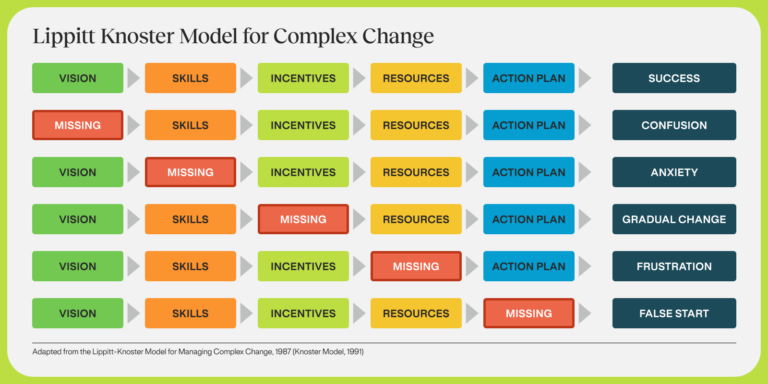
You can see in this model where each row has a red oval—this indicates which of the five elements is missing and then indicates the outcome of that at the end of the row. Only the top row—which includes all five elements necessary for complex change—results in success.
“I think this model is really helpful when working with districts to be able to think through what they already have and what they may need to intentionally nurture,” Novack says about the framework. “District leaders have to be so intentional in planning for change and in supporting teachers through that change.”
Key considerations for effective science of reading implementation
Successful implementation requires careful attention to several critical areas, each building upon the others to create a comprehensive support system.
1. Build a district-wide vision
Effective implementation begins with establishing a clear vision that extends beyond general educational goals. “A lot of districts have a vision—but perhaps not a literacy-specific vision.” Novack points out. “It’s such an important part of the process to create and communicate the literacy-specific vision to all stakeholders so that everyone can help hold the vision.”
The vision should help all invested parties understand the “why” behind the changes and how they ultimately impact student learning trajectories. This includes ensuring that everyone understands the “all means all” philosophy—that every student deserves access to effective literacy instruction.
2. Invest in professional learning
Professional learning needs to address both the knowledge foundation and practical application. “When it comes to professional learning, educators need both background in the science of reading and also training for the actual materials they’re using,” Novack explains.
She outlines three distinct but interconnected components:
- Initial training provides the overview—”this is just the getting started part—understanding the materials and how to use the pieces, including how to teach the lessons.”
- Ongoing coaching happens “at the classroom level and focuses on refining instructional practices and working directly with teachers.” Novack points out that this should include lesson observation and feedback, examining classroom data, and supporting teachers in real-time implementation.
- Implementation support operates “at the building or district level and focuses on building leader capacity to support teachers. This involves making implementation manageable by breaking down next steps and creating improvement cycles that use both student data and classroom observations to guide continuous refinement.”
In order to create the “all hands on deck” approach mentioned earlier, and to uphold the literacy vision, all three of these professional learning components are necessary.
3. Align curriculum and instructional materials
Alignment must happen both horizontally across grade levels, and vertically across tiers of instruction. Using consistent materials across grades K-5 creates a smoother process and ensures students benefit from a common language and routines so they don’t have to learn something new every year.
Across tiers, alignment means that when students need additional support, Novack points out, “they receive additional practice and support in a more intense environment rather than just teaching it in a different way.” She goes on. “If we’re teaching it in Tier 1 and students are struggling, we don’t want to necessarily teach it differently in Tier 2. It’s more about looking closely at which pieces need slowed down, intensive support so that then students can fill in the gaps that are causing them to be stuck.”
4. Use data and evidence to drive instruction
Effective implementation requires systematic data collection at multiple levels. Student data includes a strong universal screener (like DIBELS, Acadience or any good universal screener) that assesses foundational literacy skills, and diagnostic assessments (like the 95 Phonics Screener for Intervention™) to identify more specific skills gaps and to continue progress monitoring.
Equally important are instructional practices and classroom observations. “What is actually happening in the instruction? Are there effective principles of instruction in place?” Novack regularly asks herself when coaching educators. “This means ‘inspecting what you expect’ by looking for trends in areas that need improvement.”
Key areas to observe include:
- whether teachers are using the instructional dialogue and routines without adding a lot of their own additional language over teaching
- whether students are engaging in “choral responses”
- and whether teachers maintain appropriate lesson pacing
5. Plan for tiered intervention
Effective intervention systems provide increasingly intensive support while maintaining alignment with core instruction. This requires implementing structured literacy instruction based on the science of reading across all tiers, using diagnostic assessments to identify specific skill gaps, and ensuring that intervention provides additional practice and support rather than conflicting methodologies.
6. Invest in ongoing support and coaching
Long-term success requires continuing to gather feedback from teachers about their needs—including conducting needs assessments in follow-up years. Novack specifically points out that “given that implementation takes two to four years, districts have to resist the temptation to remove support after the first year.”
Critical to this ongoing support is providing time for teacher collaboration— where educators can work together, Novack says, “even if it’s simply scoring assessments together. They need this time together in order to have great conversations about their students’ learning and to help them guide future instruction.”
Turn implementation into impact
As science of reading initiatives move from planning to practice, leaders need effective ways to evaluate classroom instruction. Learn how to identify evidence-based phonics practices and support stronger implementation with A leader’s guide to evaluating phonics instruction.

3 Things to look for in a science of reading partner
When selecting partners and materials, school leaders should prioritize several key factors:
- Materials are aligned with science. They have clear evidence that demonstrates efficacy through rigorous studies showing they work with real students in schools. Resources and language should be up to date with the most current research.
- Programs include comprehensive professional learning that addresses both a depth of knowledge in the science of reading, and has specific product training—ensuring educators understand both the why and the how of implementation.
- Implementation support is designed to help move through the phases of implementation in order to get to sustainability— recognizing that each district’s journey will be unique.
How 95 Percent Group supports science of reading implementation
Every implementation is unique, requiring a true partnership approach. “Implementation is not one-size-fits-all,” Novack emphasizes. “A great implementation partner really focuses on targeting their support to the specific needs of each district or school. This means asking questions and digging in and providing the tools and resources they need to keep getting better.” Everyone’s ultimate goal must be impacting student outcomes.
Our approach works because we recognize that successful implementation requires more than materials—it demands ongoing partnership, customized support, and a commitment to helping districts navigate the complex and often challenging journey from research to classroom practice.

Case Study: Transforming reading outcomes through strategic implementation
West Warwick Public Schools in Rhode Island cracked the code. Under the leadership of Jim Monti, former Director of Educational Reform, Compliance & Technology, the district didn’t just win competitive grants—they built a sustainable literacy infrastructure that’s still thriving. Their approach combined strategic vision, smart team-building, and a relentless focus on long-term implementation over quick wins.
FAQs on science of reading implementation
The science of reading represents decades of research from multiple disciplines that reveal how children learn to read. For districts, this research provides a roadmap for implementing evidence-based literacy instruction that can dramatically improve student outcomes, particularly for readers who need extra support—including students with dyslexia.
The science of reading represents decades of research from multiple disciplines that reveal how children learn to read. For districts, this research provides a roadmap for implementing evidence-based literacy instruction that can dramatically improve student outcomes, particularly for readers who need extra support—including students with dyslexia.
Full implementation typically takes two to four years, progressing through distinct phases from initial adoption to sustainability. Districts must plan for this timeline and maintain support throughout the entire process to see meaningful results.
Full implementation typically takes two to four years, progressing through distinct phases from initial adoption to sustainability. Districts must plan for this timeline and maintain support throughout the entire process to see meaningful results.
Implementation costs vary significantly based on district size, current materials, and support needs. Consider exploring grant funding opportunities and calculating the long-term return on investment through improved student outcomes and reduced need for intensive interventions.
Implementation costs vary significantly based on district size, current materials, and support needs. Consider exploring grant funding opportunities and calculating the long-term return on investment through improved student outcomes and reduced need for intensive interventions.
Evaluate your current materials using resources like The Reading League’s curriculum evaluation tools and examine ESSA evidence ratings. Look for programs that explicitly teach phonemic awareness, phonics, fluency, vocabulary, and comprehension using systematic, explicit instruction.
Evaluate your current materials using resources like The Reading League’s curriculum evaluation tools and examine ESSA evidence ratings. Look for programs that explicitly teach phonemic awareness, phonics, fluency, vocabulary, and comprehension using systematic, explicit instruction.
Supporting teachers requires investing in professional learning for both administrative teams and educators, aligning everyone with the literacy vision, and remembering that complex change takes time and requires awareness, reflection, and persistence. For comprehensive guidance, explore leadership resources like our unique eBook The Courage to Lead Literacy, or this Literacy Leader Toolkit—both designed specifically for this transition.
The journey from research to classroom practice isn’t simple, but with systematic planning, sustained commitment, and the right partnerships, districts can successfully implement the science of reading and transform literacy outcomes for all students.
Supporting teachers requires investing in professional learning for both administrative teams and educators, aligning everyone with the literacy vision, and remembering that complex change takes time and requires awareness, reflection, and persistence. For comprehensive guidance, explore leadership resources like our unique eBook The Courage to Lead Literacy, or this Literacy Leader Toolkit—both designed specifically for this transition.
The journey from research to classroom practice isn’t simple, but with systematic planning, sustained commitment, and the right partnerships, districts can successfully implement the science of reading and transform literacy outcomes for all students.

Expert Biography
Cassandra Novack, Literacy Expert and Regional Consultant Manager, 95 Percent Group
Cassandra Novack is a seasoned education professional with a passion for literacy. Armed with Bachelor’s and Master’s degrees in Education from Washburn University, she has honed her skills across a range of roles, including classroom teacher, instructional coach, and secondary reading specialist. Today, Novack shares her expertise as a sought-after literacy consultant, helping districts and schools elevate their instruction and support student success through evidence-based, multi-tiered approaches.
Sources
- Eccles, M. P., and B. S. Mittman. 2006. “Welcome to implementation science.” Implementation Science 1 (1). https://doi.org/10.1186/1748-5908-1-1
- Joyce, Bruce, & Beverly Showers. Student Achievement Through Staff Development. 3rd ed. Alexandria, VA: Association for Supervision and Curriculum Development (ASCD), 2002
- Knoster, Timothy, Robert Villa, and Jacqueline Thousand. “Restructuring for Caring and Effective Education: Piecing the Puzzle Together.” In Managing Complex Change, edited by Mary Lippitt, 1987.