On Literacy as Freedom: A conversation with Ameer Baraka, dyslexia advocate
For the conclusion of the three-part Science of Reading 3.0 webinar series, 95 Percent Group’s Chief Academic Officer, Laura Stewart, hosted an in-depth conversation with Ameer Baraka—dyslexia activist, author, and Emmy-nominated actor. It is a powerful webinar, focusing on some of the most important issues today in achieving literacy for all. Here are some highlights to get you started, although we recommend that you take the time to watch it in its entirety.
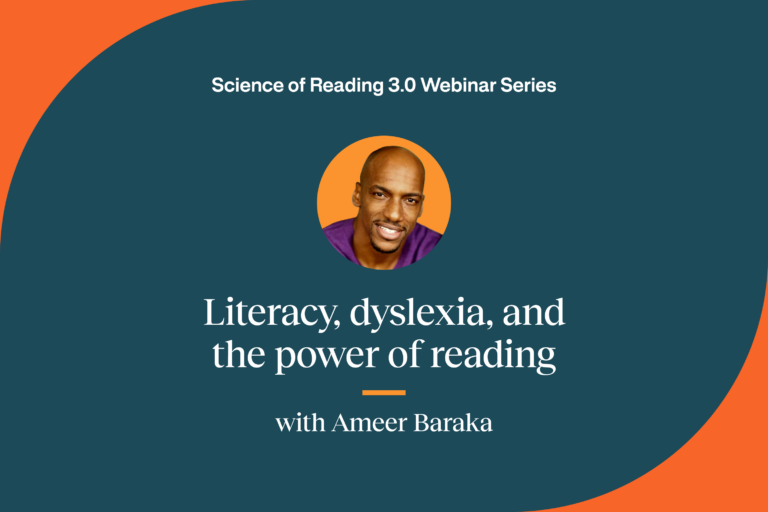
In her introduction, Laura Stewart describes her guest: “Ameer is a national voice for [dyslexia] awareness, speaking at Harvard, testifying before the U.S. Senate, and mentoring at-risk youth. His work continues to prove that, with support and determination, anyone can rewrite their story.” She explains that she first got to know Ameer Baraka when she read his book, Undiagnosed: the Ugly Side of Dyslexia.
Telling his story as healing
As the interview gets started, Ameer explains to Laura and the webinar participants how he tells his story to help eradicate all the pain he’s been through in his life. Ameer describes a violent childhood growing up in New Orleans with his mother and strict grandmother. Two of his brothers were fluent readers. But his mother and grandmother mistook Ameer’s inability to read—due to undiagnosed dyslexia—as laziness and disinterest in learning. This led to frequent and severe beatings because he couldn’t read or spell. He describes how he started skipping school.
“…I was afraid to go [to school] because I knew I would fail…” Ameer internalized the harsh and unfair judgments and beatings, and as he describes it, “spiraled out of control.”
Ameer continues, “Young people are trying to figure out ‘how do I survive…in this world that I know is about reading?’ Everything is about reading. You have to read everything. And so, when you can’t do that, you’re thinking of alternatives. That’s where I was, and so many other brothers and sisters are right now, today.”
His neighborhood in New Orleans had a shortage of economic role models for a young person who couldn’t read, but he saw one option for making an income that could work. He explains, “I knew around the third, fourth grade that I wanted to be a drug dealer. My grandmother had told us that God answered prayer, and I believed that that was my way out, so I began to pray and ask God to make me a big-time drug dealer, because I knew doing school was not for me.”
Ameer explains how he never encountered a single person in his early school years who offered any help with reading. Instead, he experienced humiliation. He describes “the straw that broke the camel’s back” in 6th grade when he was called before the class to read on the first day of school. “I knew those small words, but it was very, very excruciating to be standing in front of the class while everybody’s laughing at me. And I knew from that day on, like, okay, I’m going to be a dope dealer. …and nothing was going stop me.
“One thing led to another… I’m on this path, this trajectory down a pipe dream, robbing, stealing, doing everything that I possibly can just to stay out of the classroom. And that exacerbated the name-calling and the beatings.” At 13-years-old he started using drugs. Ameer describes this perilous time in his life. “It was just a perfect, perfect storm.”
A series of events led him to a turning point at age 23 when he found himself on a bus headed to the penitentiary with 32 men, all African Americans. When they arrived at the prison, all the men were screened for reading and math. Ironically, prison offered Ameer the first screening he’d ever received for reading issues. Only one man out of all 32 men had a GED and was told he was reading on a 6th or 7th grade level. Ameer was told he was reading on a third-grade level.
An awakening
Ameer describes this life-changing moment. “It was a huge awakening. And I realized that I have been incarcerated my entire life from a mental standpoint. It was only a matter of time before becoming physically incarcerated…What I realized was that I didn’t want to come back to prison, and so I said to myself, ‘My inability to read got me here. Now I must free myself through reading. And so, I embarked upon this journey to learn to read.”
Ameer made a serious commitment to teach himself to read by writing down and memorizing words. “For 4 years, that’s all I did, wrote words down, thousands and thousands of words, and studied the dictionary. And I eventually got my GED.” But it wasn’t until he got into school in prison, and a committed and caring teacher brought in someone to screen the students, that he first discovered the source of his reading difficulties—dyslexia.
He had never heard that word. In that moment, he understood that he had a reading disability. He was not stupid or dumb as he had learned to believe. He called his mother. “I said, ‘Mama, the teacher told me that I was dyslexic.” And she was like, “Well, what is that?” And I said, “Mama, I’m not dumb. You know, I’m not stupid. I have a reading disability.’ And our relationship began to mend at that juncture…”
Teaching is a high calling
As the conversation shifts to the role of teachers, Ameer emphasizes the power—for good and bad—that a teacher has.
“Here I was in prison…I’ve done all kinds of horrible crimes, but [my teacher] saw something in me. I don’t know what he was doing, but he was telling a bunch of black boys that we were more than criminals. And I started to believe him. Teachers are like pastors, they’re like imams, they’re like rabbis, right? And so, they have so much influence.”
Recalling Ameer’s contribution to the guide, Science of Reading 3.0, Laura and Ameer discuss the essential qualities a teacher must have to influence students in a positive way—emotional intelligence, empathy, competence with their own nervous system regulation, ability to create a safe space for students.
Ameer begins, “Teachers should be galvanized as often as possible to discuss these things, you know?” And then speaking directly to teachers, he continues, “… you are in a unique position. And a very powerful, powerful position, because you’re dealing with young learners…these people can go on, and they’re going to be the future. And you’re going to have a say in that. So that’s a great opportunity to do that. So I commend teachers. I love teachers. I thank God for teachers.”
Ending the school to prison pipeline
At the heart of this conversation is the role literacy serves in breaking the school to prison pipeline, with literacy as freedom and illiteracy as a sentence to disaster. Ameer and Laura discuss the harsh reality of the economics of the prison system today. As Ameer shares in his essay, “On literacy as freedom,” in the Science of Reading 3.0: Widening the lens on literacy guide, “Over 70 percent of America’s inmates cannot read over a 4th grade level.”
We can’t talk about breaking the school to prison pipeline without acknowledging and understanding the economics of the prison system.
“Mass incarceration is happening. Our prison systems are replete with illiterate people. I’m talking about people reading on 3rd, 4th, 5th grade levels, grown men and women. Now, we know this. We’ve been knowing this for a very, very long time; that low literacy leads to incarceration, right? But there’s a workforce that’s in the penal system.”
Ameer names some of the many consumer items made with prison labor—jeans, furniture, 15% of kitchen appliances, hats. He breaks it down, “I was in prison for 4 years, and when I got out, I got a check for $82 for 4 years of labor.”
It’s a powerful example of how reading is quite literally freedom when you connect the dots.
Calls to action for leaders
Ameer is very clear about calls to action. “First of all, teachers must be trained in the science of reading. That is so imperative, because if you know that, you can teach all kids. Right? You can teach all kids, you just don’t have to be teaching dyslexic kids, right? And so, if we can just get that right. It’s 75% of the battle….
“I know. I was in a school two years ago, talking to some teachers, and they were teaching whole language, right? And I went to the kindergarten class, and they had these cards, and they’re telling kids the word cat as opposed to c/a/t, right? They just use cat, horse, so it’s memorization. Some of these teachers don’t even know what dyslexia is. I’m like, ‘You don’t know what dyslexia is?’ A lot of kids, they’re not dyslexic, but they just haven’t been taught the proper way to learn to read. They’re falling in the cracks.”
The second call to action for leaders emphasizes the importance of screening and identifying children who have or are at risk for dyslexia early, then ensuring their teachers are equipped to give them the research-based instruction, support, and encouragement they need.
This is a rich conversation with a lot more detail from both Laura and Ameer…including Ameer’s words of wisdom to offer children and young people—wisdom gained from his own life experience. And you’ll hear about his new film project bringing his life story to the screen.

About Ameer Baraka
Ameer Baraka is a dyslexia advocate, author, Emmy-nominated actor, and national voice for dyslexia awareness. He is the author of Undiagnosed: The Ugly Side of Dyslexia and advocates for literacy, early identification, and research-based reading instruction. Ameer shares his personal experience with undiagnosed dyslexia to help educators, families, and communities understand the life-changing impact of literacy.