Fostering a love of reading in the digital age: Insights from teachers and parents
Our in-depth survey reveals how students engage with reading and what drives their habits, offering insights for educators and families to foster consistent, meaningful reading. By connecting reading to purpose and enjoyment, students build confidence and a love of learning.

The benefits of encouraging children to become avid readers are widespread: acquiring knowledge, understanding the world around them, improving memory, developing critical thinking skills, and enhancing vocabulary (to name a few). In today’s world, students face new challenges in reading, from changing curricula that stray from the science of reading to being distracted by technology. Additionally, as the NAEP Reading Report Card report shows a drop in 2024 scores for both 4th and 8th graders, there is a clear need to examine effective factors in teaching children to read and building reading habits.
We surveyed nearly 900 teachers and parents to better understand the correlation between reading for fun and academic performance, as well as how teachers are tackling reading obstacles in the classroom and encouraging students to discover the joy of reading.
K-8 educators connect reading for fun to success in the classroom
“The habits of joyful lifelong reading begin with success in the early stages of learning to read,” said Laura Stewart, Chief Academic Officer, 95 Percent Group.
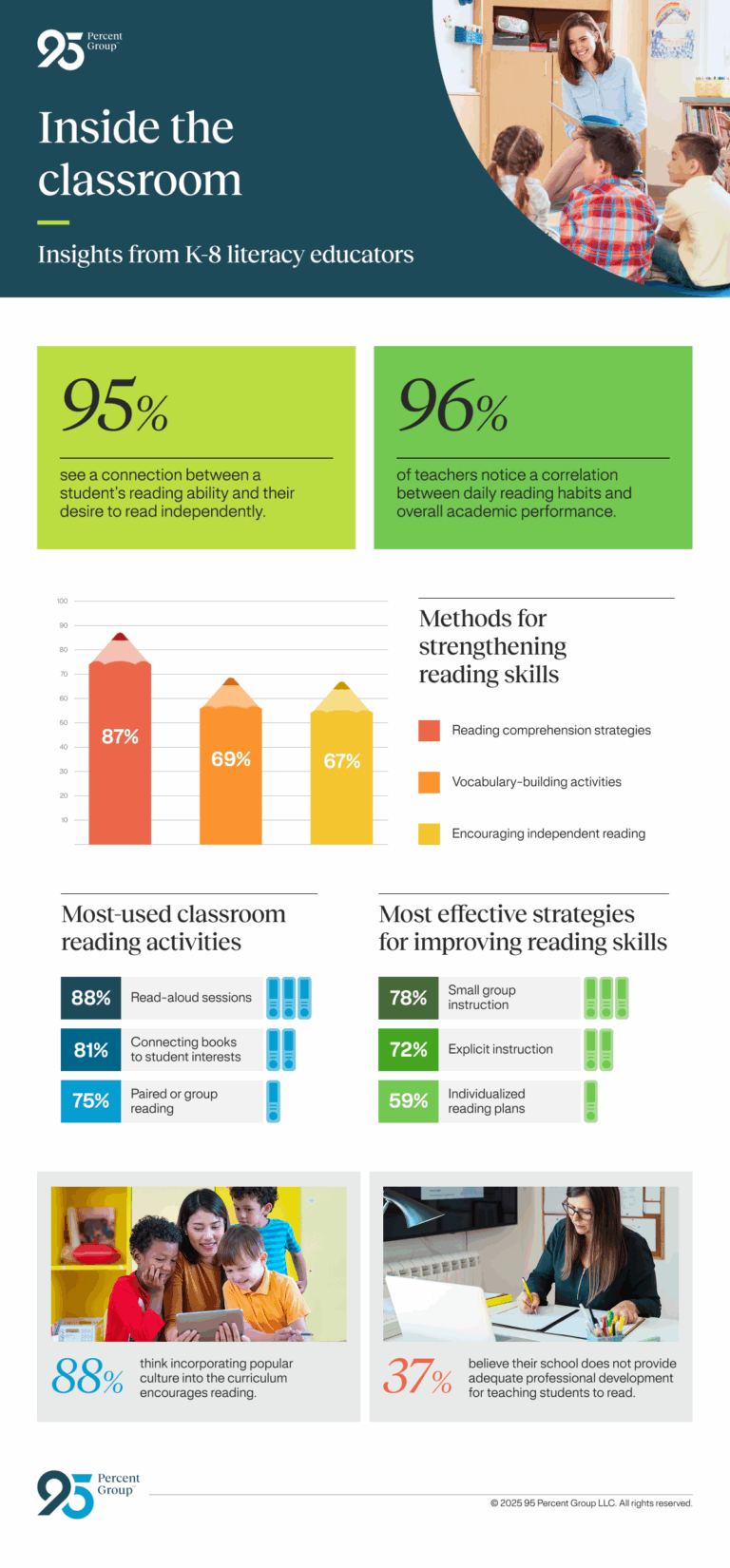
Indeed, students developing foundational reading skills and extracurricular reading habits are key signifiers for overall success. When we asked 211 K-8 literacy educators about student reading habits, nearly all of them agreed: 96% noticed a correlation between daily reading habits and overall academic performance. Additionally, 95% connect strong reading skills to a desire to read independently.
“95% of respondents see a strong connection between a student’s reading ability and the desire to read more. Success compounds! When students are successful in acquiring the ability to read, it fuels their desire to read”, said Stewart.
“This desire to read in turn provides more practice in reading, which in turn secures accuracy, automaticity, and fluency, which in turn leads to more reading of increasingly complex text.”
According to the National Reading Panel (2000), there are five key foundational reading skills that help lay the groundwork for the foundations of reading: phonemic awareness, phonics skills, reading fluency, vocabulary, and reading comprehension. Along with other foundational skills, such as oral language and writing, these capacities are vital to ensuring students learn and grow to become empowered, independent readers and writers.
“While survey respondents report using activities such as reading aloud and group reading, it is important to remember that the strategies cited for improving reading skills—small-group, explicit instruction—are key to BUILDING reading skills as well. Explicit, systematic, sequential instruction is key to laying the foundation for lifelong reading,” said Laura Stewart, Chief Academic Officer, 95 Percent Group.
Effective classroom strategies
The data reveals key insights into how educators approach literacy and which strategies they believe could be most effective, especially in foundational skill development for elementary students. According to the responding teachers in this area, the top methods for teaching reading include reading comprehension strategies (used by 87%), vocabulary-building activities (69%), and encouraging independent reading (67%).
In terms of classroom activities for students, read-aloud sessions are the most popular, with 88% of educators incorporating them into their lessons. Read-alouds are followed closely by connecting books to student interests (81%) and paired or group reading (75%).
When it comes to teachers’ strategies for improving reading skills, small group instruction (78%), explicit instruction (72%), and individualized reading plans (59%) are the most widely incorporated.
Notably, 88% of teachers say incorporating popular culture into the curriculum helps spark student interest in reading. By connecting books to current media and trends, educators can make reading feel more relevant and attractive to their students.

Readers read for real purposes. When educators can tap into students’ different interests, it invites students into reading for reasons that are relevant to them. When reading is purposeful and relevant, readers are joyfully engaged.
Laura Stewart
The role of professional learning
The need for students to develop stronger reading skills is related to both classroom methods and teacher training. 95 Percent Group believes that professional learning on the science of reading (otherwise known as science of reading training) is crucial not only to teacher support and learning development but also to the ultimate success of implementing and sustaining a literacy program and to student success. Yet our survey showed that 37% of teachers believe their school does not provide adequate professional learning for teaching children to read. This suggests a gap between what teachers need and the support and resources necessary for effective literacy instruction.
Laura Stewart noted that:
“According to the National Council on Teacher Quality, only about a quarter of the teachers who leave teacher preparation programs across our nation enter classrooms prepared to teach kids to read in a way that is aligned to the science of and research on reading. That means in-service professional development must bridge the gap. Yet 37% of teachers believe their school does not provide adequate professional development for teaching students to read. We know what works in professional learning; it must be focused, active, collaborative, sustained, and accompanied by coaching and expert support. This needs to be enacted in every school in order to achieve lasting impact on teaching practice, and ultimately, student outcomes in reading.”
What motivates students to read?
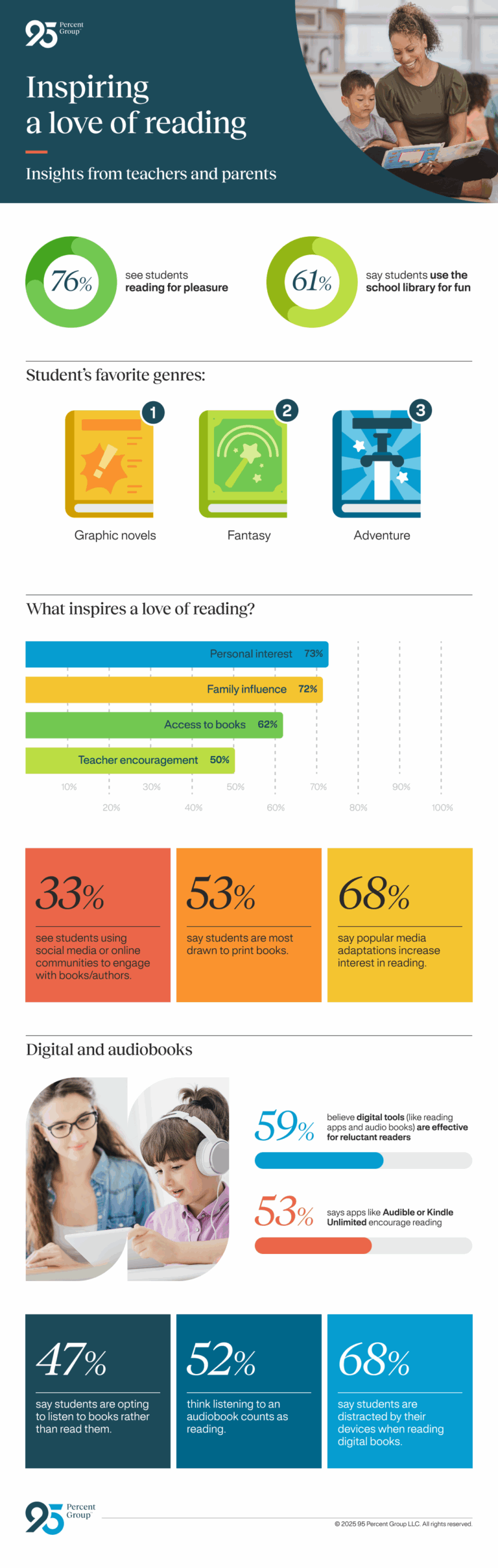
Although reading for entertainment may be on the decline, it hasn’t disappeared. According to educators and parents surveyed, they observe a significant portion of students in grades K-8 (76%) still read for pleasure, and 61% use the school library. When it comes to the types of books that students prefer, graphic novels, fantasy, and adventure genres are the most popular. This comes as no surprise, as many feature heavy visuals and captivating storylines.
Engaging young readers through personal interests
The data also indicates that students are more likely to develop a reading habit when they are surrounded by supportive environments, both at home and in school, and when they have easy access to books that align with their personal interests. The top factors that inspire a love of reading include:
- Personal interest (74%)
- Family influence (72%)
- Access to books (62%)
- Teacher encouragement (50%)
Social media and the overall digital world are also impacting young readers today. In terms of how students engage with books, 33% use social media or online communities to connect with books and authors. Despite the rise of digital media, the survey indicated 53% of readers are still most drawn to print books.
Additionally, 68% of educators believe that popular media adaptations, such as movies or TV shows, increase children’s interest in reading. Connecting books to familiar media can serve as a powerful tool for encouraging reading, as children may be interested in exploring the original sources of stories they enjoy in other formats.
The role of digital and audiobooks
While most still prefer print books, many are turning to audiobooks or reading them digitally (such as on iPads and Kindles). These formats may be helpful for young readers on the go. Over half (59%) of parents and teachers believe these digital tools are effective for reluctant readers, and 63% say apps like Audible or Kindle Unlimited are encouraging them. However, 68% say that students are distracted by their devices when reading digitally, which could potentially impact comprehension.
Does listening to audiobooks count as reading? While 47% notice that young readers are opting to listen to books rather than read print, just 52% think it actually counts as reading.
“Clearly, digital reading is here to stay, and while it can be a powerful tool for easy access to content, it can also be a distraction, impacting students’ attention and reading stamina and encouraging “shallow reading.” The circuitry for deep engagement in reading complex texts needs to be nurtured in order for our students to connect and thrive in an interconnected, complex world. But it isn’t an either/or. This is when parents and teachers need to work together to harness the power of technology while building that connection to and love for deeply engaged, sometimes challenging, but always rewarding, deep reading,” said Stewart.
The Impact of Technology and Dwindling Attention Spans
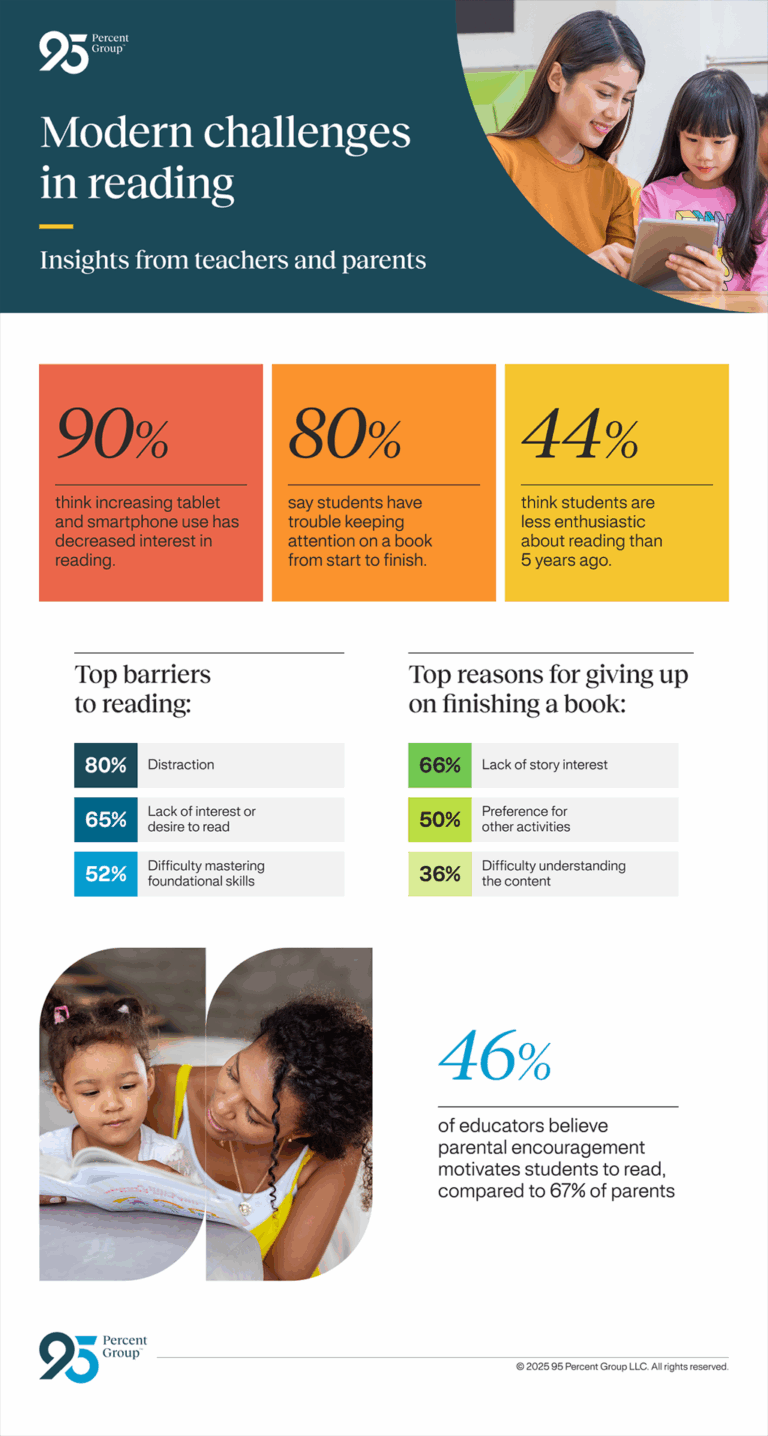
While digital book formats help many young readers consume information, the powerful draw of games and social media on devices could hinder their reading skills. Almost all parents and teachers (90%) feel that increased tablet and smartphone use has decreased interest in reading, and 44% think students are less enthusiastic about reading than five years ago.
The top-reported barriers to reading include:
- Distraction (80%)
- Lack of interest or desire to read (65%)
- Difficulty mastering foundational skills (52%)
Perhaps apps and the rise of short form videos are negatively impacting attention span as well: 80% say students have trouble keeping attention on a book from start to finish. When it comes to a student completely giving up on a book and abandoning reading it altogether, the top reasons were:
- Lack of story interest (66%)
- Preference for other activities (50%)
- Difficulty understanding the content (36%)
Our survey also revealed a disconnect between teacher and parent perspectives. While 67% of parents believe their encouragement motivates students to read, only 46% of educators agree. Although parents see themselves as powerful influences on reading habits, they may find greater success by supporting their children’s interests more broadly and ensuring they have regular access to a library and books at home.
Building strong reading habits in today’s world
In a rapidly evolving educational and digital landscape, nurturing a love of reading in children requires a collaborative effort from educators, parents, and communities. Foundational skills and evidence-based teaching strategies remain essential to helping students develop strong reading skills and thereby enabling them to experience the joy of reading. At the same time, fostering personal interest, ensuring access to books, and making reading relevant to students’ lives are also critical strategies. As distractions grow and attention spans shrink, it’s more important than ever to create environments—both in and out of the classroom—that support sustained reading habits, spark curiosity, and celebrate the joy of getting lost in a good book.
Methodology
In March, we surveyed 892 parents and teachers about children’s reading habits and progress. 391 were K-12 teachers, 211 were K-8 ELA teachers, and 501 were parents of K-8 children. Ages ranged from 18 to 74, with an average age of 40. 32% identified as male, 66% as female, 1% as non-binary, and less than 1% preferred not to say.
For media inquiries, please contact media@digitalthirdcoast.net.
Fair Use
When using this data and research, please attribute by linking to this study and citing 95 Percent Group.