Spotlight Hawaii: Building foundational skills with one aligned system
What happens when an entire school system commits to teaching every child to read? On Kaua'i, elementary schools united around one literacy framework, creating consistent instruction, stronger support systems, and transformative results for students and educators alike.
Kaua’i Complex Snapshot:
- Asian (Excluding Filipino) 9%
- Black 1%
- Filipino 29%
- Hispanic 2%
- Native Hawaiian 25%
- Pacific Islander 6%
- White 26%
- Economically Disadvantaged 47%
- Special Education 11%
- English Learners 8%
Spanning the entire island of Kaua’i, the Kapaa-Kaua’i-Waimea Complex Area serves as a single administrative region for the Hawaii Department of Education; and something uncommon is happening here. It is not just the data—though the data is remarkable. It is the way an entire complex area of schools, educators, coaches, and leaders has aligned around a single, urgent mission: making sure every child learns to read.
“We do the research; we do our homework on what we need—and then people move together,” said Sean Doi, District Educational Specialist for Kapaa-Kaua’i-Waimea Complex Area. “That’s really what makes Kaua’i unique, and we’re very proud of it.”
That spirit of collective purpose is the foundation on which everything else has been built.
We haven’t seen growth like this before.
Cathy Braun, RTI Coordinator
Systemic literacy change
For years, the Kapaa-Kaua’i-Waimea Complex Area had committed, well-intentioned educators working hard to support students who were having a hard time learning to read. But what they lacked was coherence. At the district level, approaches to literacy intervention varied from school to school, classroom to classroom—and critically, the programs serving English learners, special education students, and general education students weren’t communicating with each other.
“EL teachers might be doing one thing, and the SPED program might be doing something else entirely,” Doi explained. “And then they all funnel back to one homeroom teacher. So even though the students had the same need—decoding, and ultimately fluency—we were using too many different approaches.”
At the school level, educators were experiencing the same frustration from a different angle. “For several years we used one specific intervention program, but we weren’t seeing it transfer into the actual reading process,” said Cathy Braun, RTI Coordinator at Koloa Elementary School. “They learned all the phonics rules, but when they would go to read actual texts, it wouldn’t transfer over. This was one of our biggest problems for years.”
When a state grant opportunity arrived with a focus on structured literacy for vulnerable populations, Doi and his team saw an opportunity—not just to adopt a new program, but to build an aligned, coherent system.
“At the end of the day, we want better outcomes for our students,” Doi said. “We do this because of our students. The focus of the grant was for our students that need the most support; our at-risk readers. We needed to change lives. We needed students and families to feel successful—because reading is the cornerstone to every other subject area, to happiness and joy in life.”
Alignment: to the science and the system
We needed something systematic, and we needed robust, responsive professional development alongside it. 95 Percent Group fit that bill.
Sean Doi, Educational Specialist
After investigating options, the Complex Area turned to 95 Percent Group—drawn not just by the quality of the materials, but by the alignment of their resources and support.
“What really drew us to 95 is that we had already built background knowledge through science of reading training,” Doi explained. “We saw the alignment to what we learned, and 95 was the answer to the question of ‘now what?’—teachers needed the resources and the daily plan for how to implement what they were learning about structured literacy.”
Equally important was the confidence that the program could be implemented at scale, and with integrity. “I knew that an effective implementation would need to account for things like robust professional learning, full teacher engagement and a shared vision—even before I had the language of implementation science,” Doi said.
Leslie Labuguen, former kindergarten teacher and current complex area literacy coach, was brought on to serve as the boots-on-the-ground leader of that implementation—the coaches’ coach, the connective tissue between the district’s vision and what actually happened in classrooms.
System-level consistency, local ownership
Implementation launched in fall 2025 across the four elementary schools that were part of the Comprehensive Literacy State Development (CLSD)—each with a designated school-level literacy coach. The complex area made a deliberate decision early on: rather than mandate a single implementation model, they would hold the system constant while giving schools the autonomy to determine how to deliver it.
“We were very mindful that this would be a heavy lift for our teachers,” Doi explained. “We didn’t want to abruptly implement a new program. We had grace in mind.”
The result was a range of implementation models, each tailored to a school’s staffing and scheduling needs. For each school, the context was important.
For example:
- At one school, a grade-level “walk-to-intervention” model was adopted, with students moving to different teachers based on their assessed skill level.
- At another, three designated RTI teachers—now functioning as reading interventionists—took on all identified at-risk students across the school.
- A third school offered teachers the choice to implement in their own classrooms, with plans for a school-wide rollout in the coming year.
One approach for all students
Across all four schools, EL and special education teachers were brought into the same system—using the same program, the same language, and the same approach—for the first time ever.
“This way we can build a systematic approach across all tiers—including our vulnerable populations,” Doi explained. “Our EL and SPED teachers become reading interventionists too, using the same program and approach.”
At Koloa Elementary School, first-year literacy coach Rosalie Semana described the moment the system clicked into place. “We were learning as we went, and it just took off. It wasn’t something that felt difficult to start.”
For English learners in particular, the highly structured nature of the program made an immediate difference. “It’s very consistent and predictable. There are lots of routines embedded, so kids aren’t guessing what they’re going to do next,” Semana noted. “Once they learn the program and they’re used to the routines, it’s like, Bam!—they already know what to do. That makes it a lot easier for students who are learning to read and speak in English.”
Professional learning: The key ingredient
Without the coaches, our implementation success story would not be where it is.
Leslie Labuguen, literacy coach
The Complex Area’s investment in science of reading training—a two-year plan delivered in partnership with a consultant, reaching educators across all nine elementary schools—was not incidental to the implementation. It was foundational.
“Because our Kaua’i educators were trained in the science of reading, it felt natural to move into using 95 Percent Group resources,” Doi said. “They understand the importance of why we are doing what we’re doing.”
Professional development from 95 Percent Group was equally intentional. After standardized onboarding sessions, all subsequent coaching and PD was customized to what each school actually needed—whether that was modeling in classrooms, deeper work with the online platform, or support with assessment interpretation.
“We can’t do cookie-cutter agendas, and 95 Percent Group coaches understood this,” Doi said. “It’s not reflective of what the needs are at each school.”
Regular implementation checks—conducted by Leslie Labuguen, complex area literacy coach, alongside school-level coaches—created a feedback loop that connected instructional practice directly to student outcomes. “We can see the correlation between teacher actions and student performance,” Doi explained. “When the indicators are done right and a teacher is delivering on those, you see a change in student performance. And the converse is true too—if the instructional dialogue isn’t being followed, you see a lack of performance. That’s the data that drives the coaching cycle.”
“Without the coaches, our implementation success story would not be where it is,” Labuguen said simply. “Having that designated person at each school to be that support—we owe a lot to those literacy coaches.”
Results that speak for themselves
The data tells a story of accelerating momentum felt at every level of the system.
At Koloa Elementary School, during the 2023–2024 school year, 65% of students were making typical growth on mid-year iReady data. By the very next year, 2024–2025, that number had jumped to 71%. The 2025–2026 school year is the first full year of 95 Percent Group implementation with instruction beginning in September and the winter screener administered in December.
The results? 81% of students demonstrated typical growth. That’s a 10 percentage point increase from the prior year, achieved in a single school year.
Shifting more than numbers
Their mindsets were changed about how to teach reading.
Rosalie Semana, literacy coach
The shift in the intervention population has been equally striking. The school went from serving 101 students in Tier 3 pull-out intervention at the start of the year to just 50—a reduction that includes students receiving special education and English learner services. “Because it’s so straightforward on where to exit students and we can see the progress, by spring, half of the kids have cycled out of intervention already,” said RTI Coordinator, Braun, enthusiastically. “And they’re not just learning the skills—they’re actually applying the skills in real time.”
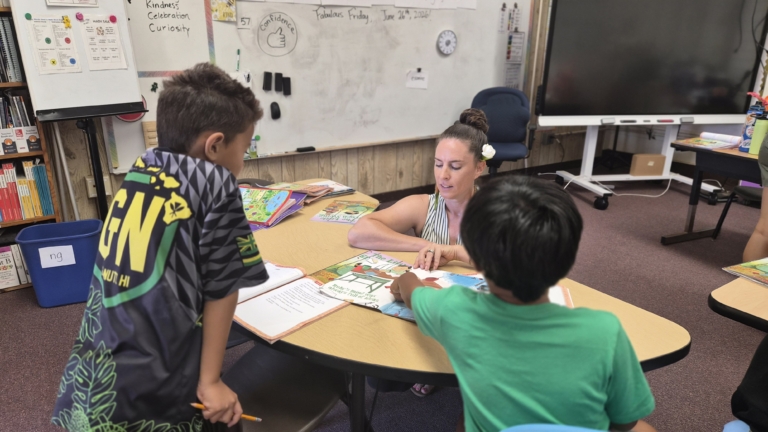
There are many stories of how students in the Complex Area have grown their literacy skills this year. This one in particular is a great example of the felt impact. Twins—who arrived in the fall semester of their 2nd grade year, were in need of a lot of foundational skills support. This past year they began work with 95 Percent Group resources and one of the students was able to exit intervention entirely after one semester and has ended the year with 436% growth on screener data. “Everybody had been trying their best to reach this particular student,” Semana reflected. “But the systematic approach that we have been able to take with 95 Percent Group resources helped to move this student out of RTI entirely.”
Teachers, too, are being transformed. “They’re really seeing the science of reading come to life,” Labuguen observed. “Even teachers who weren’t originally trained in the science of reading—they see that what they’re delivering in their groups is working. And that has given them the motivation to keep going.”
At Koloa Elementary School, third grade teachers who observed intervention sessions reported a meaningful shift in perspective. “Their mindsets were changed about how to teach reading,” Semana said. “They have more of an appreciation for teachers in grades K-2 who have the challenge of teaching students how to read.”
A new and welcome challenge
When students test out of the intervention scope and sequence, it has become a moment of genuine celebration across the complex area. But it has also created something the schools have never had to contend with before.
“We didn’t think we’d get to this point,” Semana said. “We started at skill two or skill three, and by spring, they’re already at skill 12. They’re going to hit skill 15 before the school year ends!”
For the first time, schools are forming comprehension groups—because enough students have built the foundational skills to need that next level of support. “We haven’t seen growth like this before,” Braun said. “This is our first year even having comprehension groups, because we’ve been so focused on catching up students with their phonics and phonemic awareness.”
Their “why”
Leila Kobayashi, Complex Area Superintendent, offered a perspective that captures the broader significance of what is happening on the island of Kaua’i.
“We want all of our kids to be able to read—that’s the bottom line. Here is a way that takes all the science plus research-backed material, and gives you a way to do it that teachers can really understand. With the right support, it is possible. It works.”
Doi agreed. “We have such incredible people here on Kaua’i,” he said, smiling.
And this is at the heart of it all. Something that cannot be manufactured—a culture of mutual respect, shared purpose, and collective movement toward better outcomes for every child.
Bring alignment to your district
Kaua‘i’s story is a reminder that lasting literacy improvement doesn’t happen through isolated initiatives. It happens when educators share a common purpose, a common language, and a common commitment to every student’s success. When systems align around what works, transformative outcomes become possible.
To learn how your school or district can build a cohesive, science-aligned literacy system, connect with a 95 Percent Group literacy specialist.

Bring this success story to your team
Download this literacy transformation story and share with district leaders, literacy teams, school administrators, and instructional coaches.